Exponential and Logarithmic Functions
Exponential functions grow by multiplying, logarithmic functions grow by counting multiplications. One models spread and decay, the other reads it back on a human scale.
Why Does This Exist?
Two shapes run the quantities ML cares about. Populations, virality, compounding returns and exploding gradients grow exponentially: multiply per step, and the curve goes vertical. Measurement, bits, magnitudes and learning curves grow logarithmically: count the multiplications, and thousand-fold spans fit on one axis.
They are inverses, mirror images across the line . Exponentials answer "how much after steps"; logs answer "how many steps to reach ". Solving equations built from them is exponential and logarithmic equations; the log rules themselves are in logarithms.
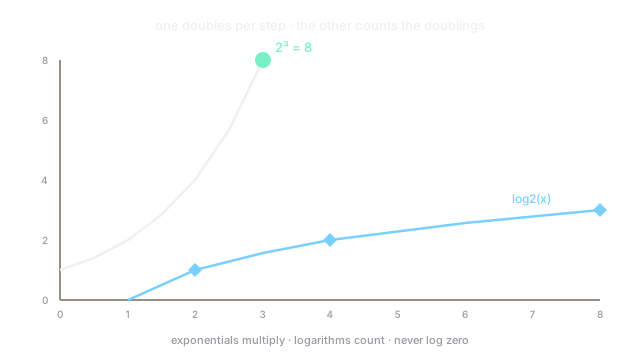
The one idea you need first. says three doublings reach eight. counts them back. Growth multiplies; the log counts the multiplications. Hold both directions at once and the pair is simple.
Think of It Like This
A rumour and its contact tracer
A rumour spreads exponentially: each hearer tells two friends, so 1 becomes 2, 4, 8, doubling per round. The contact tracer works logarithmically: given 8 hearers, how many rounds ran? Three. The tracer counts doublings the way the rumour performs them.
Neither job replaces the other. The rumour predicts load; the tracer reconstructs history. Confuse them and you either expect linear spread from a compounding process or demand round-by-round logs from thin air.
Where it stops: rumours saturate when everyone has heard, while pure exponentials never do. Real growth is logistic; the exponential is its early phase, which is exactly the phase ML usually models.
How It Actually Works
Exponential form: with base , . Growth for , decay for . The special base makes calculus clean, since is its own derivative. Doubling time satisfies ; with 10% growth per period, gives periods. Half-life mirrors it: after half-lives.
Logarithmic form: , defined for , the exact inverse. It climbs steeply near zero... gently: from 1 to 10 takes as much horizontal room as 10 to 100, each decade one unit on a base-10 log. Small inputs near zero plunge toward negative infinity, which is why log-scales never touch the axis.
Worked example: a culture, a half-life and a count of doublings
Culture: cells doubling every hours. After hours, three doublings: cells.
Half-life: g with a -hour half-life. After hours: g.
Count: , because . Five doublings from 1 reach 32, and the log counted them. The diagram above draws both directions: the climb through and the stroll through .
Code
cells: int = 500for _ in range(3): cells *= 2print(cells) # -> 4000
import mathprint(math.log2(32)) # -> 5.0print(100 * (0.5) ** 3) # -> 12.5The loop performs the doublings one by one, the honest version of exponentiation. The log line counts them back. The last line is the half-life in one expression: three halvings of 100.
Watch Out For
Exponentials overflowing to infinity
is about , far past float64's ceiling near , so softmax-style code exponentiates straight to inf and then divides inf/inf into NaN. The symptom is a loss that is fine for epochs, then NaN on one unlucky batch with large logits.
Subtract the max before exponentiating: exp(x - max(x)). Work in log-space wherever the math allows. Overflow is not a rare edge; it is the default fate of raw exponentials.
Logging zero in a measurement pipeline
is negative infinity, and any zero count, empty bin or exact-zero probability feeds it directly. Dashboards show -inf, downstream means become NaN, and the pipeline stays green because no exception fired.
Add epsilon before the log or filter zeros explicitly: math.log(x + 1e-12). Decide the floor on purpose instead of discovering negative infinity in a report.
The Quick Version
- multiplies per step: growth above 1, decay below it, for calculus.
- counts the multiplications; defined only for positive .
- Doubling triples 500 to 4000 in three rounds; three half-lives cut 100g to 12.5g.
- Raw exponentials overflow past : subtract the max first.
- Never log raw zeros; set an epsilon floor deliberately.