Definite and Indefinite Integrals
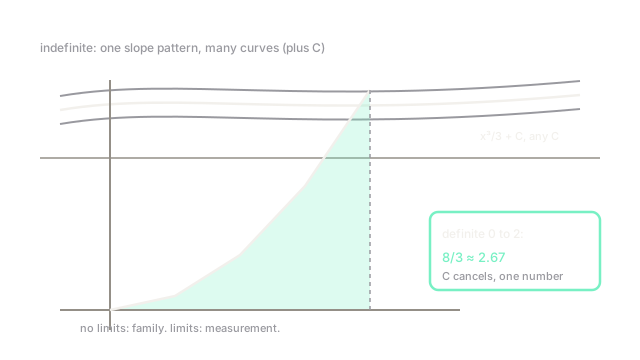
An indefinite integral is the whole family of curves sharing one slope pattern; a definite integral picks two endpoints and returns one number.
Why Does This Exist?
Expected values, marginal probabilities, and cumulative metrics are definite integrals: single numbers with units. Recovering a position from velocity data, or a loss from its gradient field, is an indefinite integral: a family of curves differing by a starting offset. Confusing the two produces answers with the wrong shape entirely, a function where a number belongs or a number where a curve belongs.
Integration and area builds the area intuition. This page draws the boundary both notations share: when the integral sign carries limits it computes, and when it does not it describes.
The one idea you need first
An antiderivative of is any with . Since constants differentiate to zero, antiderivatives come in families: if works for , so does . That is not decoration; it is the whole difference between the two integral kinds.
Think of It Like This
A speedometer with and without a trip meter
An indefinite integral is a speedometer history with no starting odometer: from speeds alone you reconstruct the route's shape but not its position, every reconstruction shifted by the unknown starting mile. The is that unknown start.
A definite integral sets two trip-meter presses, at mile 0 and mile 2, and reports one number: distance covered between presses. Same speeds, but the endpoints pin the answer down to miles. Limits are the trip meter; without them you own a shape, with them you own a measurement.
How It Actually Works
Indefinite integral: a function family. collects every antiderivative. Example: , because differentiating returns for any constant . No limits, no number, just the family.
Definite integral: one number. evaluates the family at both endpoints and subtracts, so every cancels: . Limits, one number, units of times units of .
Worked example
Integrate both ways.
Indefinite: . Verify by differentiating: . Members include , , : parallel curves, identical slopes everywhere.
Definite from 0 to 2: . One number, about 2.67 square units. Any you carried cancels in the subtraction, which is why definite answers never mention it.
Watch Out For
Dropping the plus C in the indefinite case
The symptom is a "general solution" that misses most solutions: reporting as the antiderivative silently discards every vertical shift, and downstream initial conditions then have nothing to grip. In ML this bites when reconstructing potentials or integrating gradient fields: one integration constant per component, each needing its own condition. Write every time the limits are absent, and trade it for a fitted constant the moment data arrives.
Handing a function where a number belongs
The symptom is a probability or expectation left as an unevaluated antiderivative: correct shape, wrong type, and every consumer breaks. Definite integrals answer "how much"; indefinite integrals answer "what shape." If the question names endpoints ("from 0 to 2," "over the batch," "expected value"), evaluate at both and subtract. If it asks for the family ("solve," "recover," "find all"), keep and stop.
The Quick Version
- Indefinite integrals return curve families: .
- Definite integrals return numbers: .
- The cancels in , so definite answers never carry it.
- No limits means describe the family; limits mean compute the measurement.
- Always verify by differentiating the antiderivative back.
- Shape questions want ; "how much" questions want endpoints evaluated.