Special Matrices
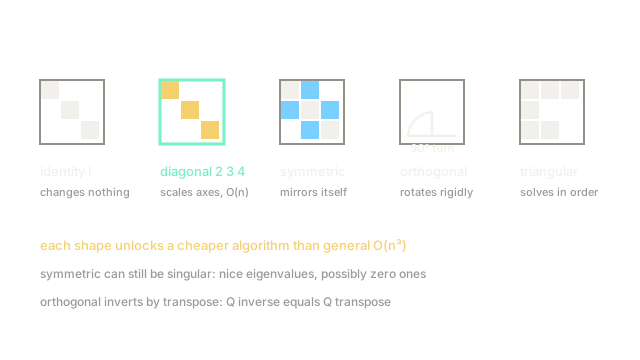
A few matrix shapes keep showing up because they compute fast and behave well: identity changes nothing, diagonal scales axes, symmetric mirrors itself, orthogonal rotates, triangular solves quickly.
Why Does This Exist?
General matrices cost general effort: multiplying two matrices costs on the order of operations. But ML runs on matrices with structure, and structure buys speed and guarantees. Covariance matrices are symmetric, which guarantees real eigenvalues. Attention masks are triangular, which enforces causality. Normalization layers lean on diagonals, and rotations in graphics and embeddings are orthogonal, which preserves lengths exactly.
Matrix operations covers how matrices combine. This page catalogs the five shapes worth recognizing on sight, with what each shape buys you.
The one idea you need first
A matrix's shape of nonzeros decides its cost. Multiplying by a general takes 27 multiplications, but multiplying by a diagonal takes 3, because the zeros contribute nothing. Every entry below is a version of that bargain.
Think of It Like This
Specialist tools on a workbench
A general matrix is an adjustable wrench: it does everything slowly. The five shapes here are fixed-size spanners. Identity is the pass-through gauge that changes nothing, diagonal is five separate volume knobs with no crosstalk, symmetric is a mirror you can trust to reflect evenly, orthogonal is a rigid rotation of the whole bench, and triangular is an assembly line where each station only needs earlier stations done.
Nobody builds furniture with one adjustable wrench when the spanner set hangs within reach. Numerical code reaches for these shapes the same way, because each one turns an expensive general routine into a cheap special case.
How It Actually Works
Identity (): ones on the diagonal, zeros elsewhere. Changes nothing: for any compatible . The identity is .
Diagonal (): nonzero only on the diagonal. Scales each axis independently: maps to . Multiplication and inversion cost instead of , and .
Symmetric (): mirrors itself, . Covariance matrices look like , unchanged by transposing. Symmetric matrices have real eigenvalues and perpendicular eigenvectors, which is why spectral methods trust them.
Orthogonal (): columns are unit length and mutually perpendicular, . Rotations and reflections qualify; e.g. a 90 degree rotation . Lengths and angles survive: . Inversion is free: .
Triangular (, ): zeros above (lower) or below (upper) the diagonal. The system solves in order: gives , then gives . No elimination needed, just forward substitution in .
Watch Out For
Assuming symmetric means invertible
Symmetry guarantees nice eigenvalues, not nonzero ones. The matrix is symmetric and singular: both rows agree, so no inverse exists. The symptom is a Cholesky or inverse call failing on a covariance matrix that "should" work, usually because duplicated or constant features made it rank deficient. Check the determinant or condition before inverting, and regularize with a small diagonal nudge when the math allows it.
Calling a matrix orthogonal because it looks symmetric
Orthogonal is much stricter than symmetric: every column must have unit length and all pairs must be perpendicular. The symptom is a "rotation" that quietly stretches space because its columns were normalized in only one axis. Verify with the definition, , computed directly: if the product is not the identity, it is not orthogonal, however square and tidy it looks.
The Quick Version
- Identity changes nothing: .
- Diagonal scales axes independently with inversion.
- Symmetric mirrors itself () with real eigenvalues, but can still be singular.
- Orthogonal rotates rigidly (), preserves lengths, and inverts by transposing.
- Triangular systems solve in order by substitution, skipping elimination.
- Recognize the shape first, because each shape earns a cheaper algorithm.