The Spectral Theorem
Every symmetric matrix has a full team of perpendicular eigenvectors with real eigenvalues. That guarantee is the spectral theorem, and PCA is built on it.
Why Does This Exist?
Plenty of matrices misbehave: complex eigenvalues, missing eigenvectors, bases that skew. The spectral theorem draws a fence around the well-behaved territory: real symmetric matrices always diagonalise orthogonally, with real eigenvalues and a full orthonormal eigenbasis. No exceptions, no edge cases.
That guarantee is load-bearing across ML. PCA trusts the covariance's eigenvectors as uncorrelated directions because the theorem says they exist and are perpendicular. Quadratic forms get clean upper and lower bounds from the extreme eigenvalues. Positive definiteness becomes a check on eigenvalue signs rather than a vague property. Whenever a proof starts "since is symmetric...", the spectral theorem is the sentence being invoked.
The one idea you need first
An eigenpair satisfies : direction preserved, length scaled. Eigenvalues and eigenvectors finds them; diagonalisation assembles them when possible. The spectral theorem says assembly always succeeds for symmetric matrices, with orthonormal parts.
Think of It Like This
A building with guaranteed fire stairs
Most buildings have some escape route, but proving it takes a floor-by-floor inspection. A certified building guarantees by construction: every floor connects to two independent stairwells, no inspection needed.
The spectral theorem is that certificate for symmetric matrices. A general matrix needs inspection (is it defective? are eigenvalues complex?). A symmetric matrix carries the guarantee by construction: full eigenbasis, real spectrum, perpendicular axes. Algorithms like PCA and spectral clustering move into this building precisely so they never need the inspection.
How It Actually Works
The theorem: if with real entries, then where is orthogonal and is real diagonal. Three consequences run the applications:
- Real spectrum: no complex eigenvalues to interpret, ever. Stability analysis stays on the real line.
- Orthonormal eigenbasis: the eigenvectors can be chosen mutually perpendicular with unit length, so projections decouple and Parseval-style energy splits hold.
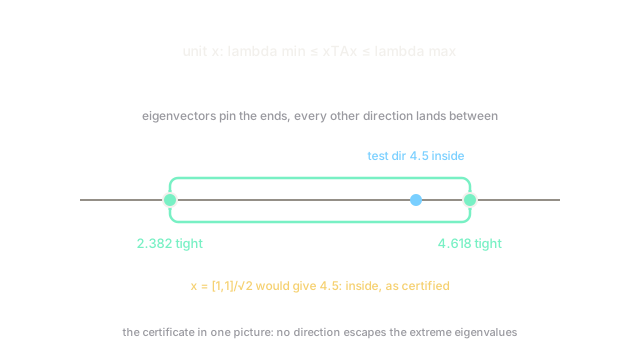
- Variational bounds: for unit , . Every direction's quadratic energy is fenced by the extreme eigenvalues.
Worked example
Take the symmetric from the eigendecomposition page, with eigenvalues and . Test the bounds at with :
The theorem predicts , that is . It holds with room to spare. At an eigenvector the bounds go tight: exactly. Energy accounting with no leaks.
Code
The point is the check: verify all three guarantees numerically on one matrix.
import numpy as np
A = np.array([[4.0, 1.0], [1.0, 3.0]])w, Q = np.linalg.eigh(A)print(np.all(np.isreal(w))) # -> Trueprint(np.allclose(Q.T @ Q, np.eye(2))) # -> Truex = np.array([1.0, 1.0])x = x / np.linalg.norm(x)print(w[0] <= x @ A @ x <= w[-1]) # -> TrueReal spectrum, orthonormal basis, variational bounds: the whole theorem in three boolean checks.
Watch Out For
Invoking the theorem on a merely almost-symmetric matrix
Covariances assembled as are symmetric up to rounding, but Hessians from autodiff or adjoints from iterative solvers can carry asymmetric errors of that break exact symmetry. The theorem's guarantees degrade gracefully, yet code asserting exact from a general eig call fails. Symmetrise explicitly ((A + A.T) / 2) before claiming the certificate.
Expecting distinct eigenvalues
The theorem guarantees an orthonormal basis, not distinct eigenvalues: the identity matrix has eigenvalue 1 with multiplicity , and any orthonormal basis qualifies. Algorithms that divide by eigenvalue gaps (some perturbation bounds, certain spectral projectors) still blow up on repeated spectra. Orthogonality is guaranteed; separation is not.
The Quick Version
- The spectral theorem certifies symmetric matrices: real eigenvalues, full orthonormal eigenbasis.
- PCA, quadratic-form bounds and definiteness tests all spend this guarantee.
- Unit directions satisfy ; eigenvectors make it tight.
- The worked matrix obeys at .
- Symmetrise numerically asymmetric inputs before claiming the certificate.