Goal-Conditioned Reinforcement Learning
Goal-Conditioned Reinforcement Learning trains agents to achieve any arbitrary target state rather than solving a single narrow task. By parameterizing policies and value functions with goal vectors using Universal Value Function Approximators, a single neural network generalizes turn-by-turn navigation across millions of destinations.
Why Does This Exist?
In classical reinforcement learning, an agent learns a specialized policy to maximize expected return for a single, fixed reward function . If the operational target changes—such as commanding a robotic arm to place a block at coordinate instead of , or instructing an autonomous vehicle to navigate to a new delivery address—the learned policy is helpless. The weights of the neural network bake in a single target destination, requiring the entire system to be retrained from scratch.
Training separate individual policies for every conceivable destination is computationally impossible and ignores the shared physics of the world. Moving an arm forward follows the identical motor dynamics regardless of whether the final goal is five inches to the left or ten inches to the right.
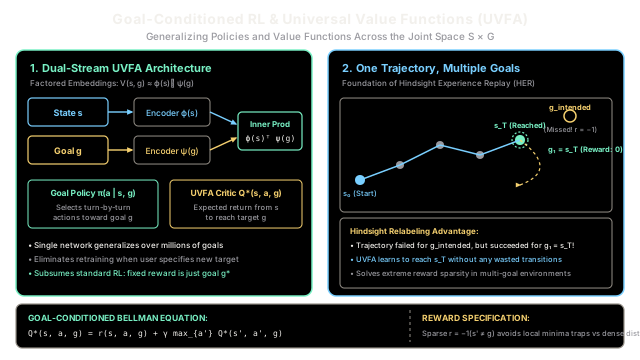
Goal-Conditioned Reinforcement Learning (GCRL), pioneered by Kaelbling (1993) and formalized with deep neural networks through Universal Value Function Approximators (UVFA) by Schaul et al. (2015), reformulates reinforcement learning to consider an entire family of tasks parameterized by a goal .
By feeding the target goal directly into the policy and value function , GCRL achieves three major breakthroughs:
- Zero-Shot Multi-Goal Generalization: A single compact neural network learns to navigate from any starting state to any arbitrary destination across the entire environment.
- The Theoretical Foundation for Hindsight Relabeling: Because the goal is an explicit input, any failed trajectory that missed its intended goal can be relabeled in memory with the state it actually reached , transforming 100% of exploratory "failures" into successful training demonstrations (the core mechanism of Hindsight Experience Replay).
- The Core Engine of Hierarchical RL: High-level managers in hierarchical architectures (such as FeUdal Networks and HIRO) coordinate complex missions by generating intermediate sub-goals , which low-level goal-conditioned policies execute over short horizons.
Think of It Like This
A universal in-car GPS navigation system
Imagine navigating a city using two different styles of automated driving assistants.
A standard single-task RL system is like a car hardwired exclusively to drive you from your office to your home address. Its internal computer has memorized a rigid sequence of actions: "Turn right at Main Street, merge onto Highway 101, take Exit 4." If you step into the car and ask it to drive to the airport, the hospital, or a friend's house, the system is completely blind. You would need to buy a separate car—and train a separate neural network from scratch—for every single building in the city.
A Goal-Conditioned RL system is a modern in-car GPS navigation computer:
- It accepts two simultaneous inputs: where you currently are (the state ) and where you want to go (the goal ).
- It utilizes a single universal value function () that computes the remaining travel time or distance between any arbitrary pair of coordinates.
- Its policy () outputs turn-by-turn maneuvers toward the target. If you make a mistake and take a wrong turn, the GPS does not shut down in confusion; it instantly evaluates your new state against goal and recalculates the optimal maneuver.
- Furthermore, if you miss your freeway exit for the airport and accidentally pull into a gas station, a Goal-Conditioned system notes: "I failed to reach the airport, but I just discovered the fastest route from the highway to this gas station!" (Hindsight Relabeling).
Where the analogy stops: a consumer GPS operates over static, pre-surveyed road maps with pre-calculated distances. A Goal-Conditioned RL agent begins with zero map knowledge, learning spatial connectivity, obstacle collisions, and motor kinematics entirely through trial-and-error exploration.
How It Actually Works
Universal Value Function Approximators and Goal-Conditioned Bellman Optimality
Goal-Conditioned RL formalizes tasks as a Goal-Conditioned Markov Decision Process (GCMDP), defined by the tuple :
- is the state space and is the action space.
- is the goal space, where goals are sampled from distribution . Often , or states are mapped to goals via a projection function .
- is the environmental transition dynamics.
- is the goal-conditioned reward function.
┌────────────────────────────────────────────────────────┐ │ Universal Value Function (UVFA) │ └───────────────────────────┬────────────────────────────┘ │ ┌────────────────────────────┴────────────────────────────┐ │ │┌─────▼─────────────────────────┐ ┌─────────────────▼──────────────────┐│ State Representation ϕ(s) │ │ Goal Representation ψ(g) ││ Deep feature embedding of │ │ Deep feature embedding of ││ current environment state s │ │ target destination goal g │└─────────────┬─────────────────┘ └─────────────────┬──────────────────┘ │ │ └────────────────────────┬────────────────────────┘ │ ▼ ┌──────────────────────────────────────┐ │ Factored Dot Product or Joint MLP: │ │ V(s, g) ≈ ϕ(s)ᵀ ψ(g) │ │ Q*(s, a, g) = r(s,a,g) + γ max Q* │ └──────────────────┬───────────────────┘ │ ▼ ┌──────────────────────────────────────┐ │ Goal-Directed Policy π(a | s, g) │ │ Controls agent toward target state │ └──────────────────────────────────────┘1. Goal-Conditioned Reward Formulations
The choice of reward function dictates whether the agent learns optimal shortest paths or gets trapped in local minima:
A. Sparse Indicator Rewards (Standard in GCRL)
The environment penalizes the agent at every step until the state projection falls within an acceptance radius of the goal:
Under a discount factor , the optimal value function directly reflects the negative discounted number of steps required to reach the goal:
Because every non-goal step costs , the policy is mathematically incentivized to discover the strictly shortest temporal path.
B. Dense Distance-Based Rewards
Alternatively, rewards can provide continuous gradient feedback based on negative Euclidean distance:
While dense rewards simplify learning in open terrain, they introduce dangerous local minima traps in environments with walls, mazes, or obstacles.
2. Universal Value Function Approximator (UVFA) Architectures
Schaul et al. (2015) introduced two primary neural architectures to parameterize and :
The Concatenated Joint Architecture
States and goals are concatenated into a single input vector and passed through a multi-layer perceptron (MLP):
This approach allows deep non-linear feature interactions between states and goals, making it the standard choice for continuous robotics and manipulation tasks.
The Factored Embedding Architecture
States and goals are processed by separate neural networks into shared embedding spaces of dimension :
- State encoder:
- Goal encoder:
The value function is computed via their inner product:
This factored formulation enables bilinear structural generalization and permits fast nearest-neighbor lookups when searching for goals across massive state spaces.
3. The Goal-Conditioned Bellman Equation
The Bellman optimality equation extends naturally across the Cartesian product of states and goals :
During training, experience replay transitions are stored as tuples . The Critic minimizes the temporal difference error across arbitrary sampled goals:
4. The Foundation for Hindsight Experience Replay (HER)
Because the goal is an explicit input rather than an environmental constant, transitions can be relabeled in hindsight. If an agent was commanded to reach target but wandered off and reached state , standard RL discards the trajectory as a total failure ( at every step).
In GCRL, the trajectory is stored twice:
- Once with the original intended goal (where it failed).
- Once with an alternative relabeled goal (where it succeeded, earning ).
This relabeling mechanism provides non-zero positive training gradients even when the agent has zero probability of randomly stumbling onto the original target.
Worked numerical example
To observe how goal-conditioned Q-values guide navigation, consider an agent operating in a 2D continuous plane navigating toward target destination .
- Current position: .
- Action set: with step size .
- Discount factor: .
- Reward structure: Sparse step penalty until reaching within of the goal, where .
Step 1: Candidate Next States and Distance Analysis
The agent evaluates candidate actions:
- Action (North): Moves to . Manhattan distance to goal: . Suppose environment obstacles require an optimal remaining path of steps from .
- Action (South): Moves to . Manhattan distance to goal: . Due to moving away from the target, the optimal remaining path requires steps from .
Step 2: Analytical Discounted Remaining Return Calculation
Under an optimal policy, the discounted return for remaining steps of penalty is:
- For Action ( steps from ):
- For Action ( steps from ):
Step 3: Goal-Conditioned Bellman Q-Value Evaluation
Using the goal-conditioned Bellman equation :
- For Action :
- For Action :
Step 4: Policy Action Selection
The goal-conditioned policy selects the action that maximizes :
Because , the agent chooses North, advancing along the shortest discounted path toward destination .
Code
The following self-contained Python script implements the UniversalValueFunctionApproximator class, computes goal-conditioned returns, evaluates Bellman updates across multiple candidate goals, and verifies the worked numerical example with automated assertions.
from typing import Dict, List, Tupleimport numpy as np
class UniversalValueFunctionApproximator: """Goal-Conditioned RL and Universal Value Function Approximator (UVFA) evaluator."""
def __init__(self, gamma: float = 0.90, step_penalty: float = -1.0) -> None: self.gamma = gamma self.step_penalty = step_penalty # Discrete 2D action offsets self.action_vectors: Dict[str, np.ndarray] = { "N": np.array([0.0, 1.0], dtype=np.float64), "E": np.array([1.0, 0.0], dtype=np.float64), "S": np.array([0.0, -1.0], dtype=np.float64), "W": np.array([-1.0, 0.0], dtype=np.float64), }
def compute_optimal_remaining_value(self, steps_remaining: int) -> float: """Analytical discounted return for D remaining steps under sparse -1 penalty.""" if steps_remaining <= 0: return 0.0 return float(- (1.0 - (self.gamma ** steps_remaining)) / (1.0 - self.gamma))
def evaluate_goal_q_value( self, current_state: np.ndarray, action: str, goal: np.ndarray, remaining_steps_from_next: int, ) -> Tuple[np.ndarray, float, float]: """Computes next state and goal-conditioned Q-value Q*(s, a, g).""" next_state = current_state + self.action_vectors[action] v_next = self.compute_optimal_remaining_value(remaining_steps_from_next) q_val = self.step_penalty + self.gamma * v_next return next_state, v_next, float(q_val)
def select_best_action( self, current_state: np.ndarray, goal: np.ndarray, action_step_estimates: Dict[str, int], ) -> Tuple[str, float]: """Greedy action selection over goal-conditioned Q-values.""" best_action = "" best_q = -float("inf") for act, steps in action_step_estimates.items(): _, _, q = self.evaluate_goal_q_value(current_state, act, goal, steps) if q > best_q: best_q = q best_action = act return best_action, best_q
# --- Verification Matching Worked Example ---uvfa = UniversalValueFunctionApproximator(gamma=0.90, step_penalty=-1.0)s = np.array([1.0, 1.0], dtype=np.float64)g = np.array([4.0, 4.0], dtype=np.float64)
# 1. Action N: D = 6 remaining steps from next states_next_n, v_rem_n, q_n = uvfa.evaluate_goal_q_value(s, "N", g, remaining_steps_from_next=6)print(f"Action N: Next State={s_next_n}, V_rem={v_rem_n:.4f}, Q*={q_n:.3f}")# -> Action N: Next State=[1. 2.], V_rem=-4.6856, Q*=-5.217
# 2. Action S: D = 8 remaining steps from next states_next_s, v_rem_s, q_s = uvfa.evaluate_goal_q_value(s, "S", g, remaining_steps_from_next=8)print(f"Action S: Next State={s_next_s}, V_rem={v_rem_s:.4f}, Q*={q_s:.3f}")# -> Action S: Next State=[1. 0.], V_rem=-5.6953, Q*=-6.126
# 3. Policy Action Selectionstep_estimates = {"N": 6, "S": 8}best_act, best_q = uvfa.select_best_action(s, g, step_estimates)print(f"Optimal Goal-Conditioned Action: {best_act} with Q*={best_q:.3f}")# -> Optimal Goal-Conditioned Action: N with Q*=-5.217
# Assertions verifying worked example calculationsnp.testing.assert_allclose(q_n, -5.217, atol=1e-3)np.testing.assert_allclose(q_s, -6.126, atol=1e-3)assert best_act == "N", "Policy must select North (N) toward goal"print("All UVFA assertions verified successfully.")# -> All UVFA assertions verified successfully.Watch Out For
The Goal Horizon Disconnect and Local Minima Trap
A common failure mode when designing Goal-Conditioned RL architectures is replacing sparse indicator rewards with dense negative Euclidean distance () under the assumption that it will accelerate learning.
The Symptom: When an agent encounters obstacles—such as a U-shaped barrier, maze wall, or table edge—the optimal path requires moving temporarily away from the goal to find the hallway door. Because dense distance rewards greedily punish any step that increases Euclidean distance, the agent becomes trapped in a severe local minimum, pressing itself permanently against the barrier wall directly facing the goal coordinate.
The Fix:
- Rely on Sparse Rewards + Hindsight Experience Replay (HER): Maintain sparse indicator rewards () so the agent remains incentivized to discover detours without myopic distance distortion, utilizing HER to eliminate sample inefficiency.
- Quasimetric or Contrastive Embeddings: If dense distance shaping is necessary, do not use naive Cartesian distance . Instead, train a contrastive representation or quasimetric distance network (such as Contrastive RL or Successor Representations) that models dynamical graph reachability distance, ensuring that states on opposite sides of a physical wall have large representational distances.
The Quick Version
- Goal-Conditioned RL (GCRL) parameterizes policies and value functions by arbitrary target destinations , enabling a single neural network to solve infinitely many goal-directed tasks.
- Universal Value Function Approximators (UVFA) model the joint space via concatenated MLPs or factored state-goal embeddings (), generalizing across millions of unseen coordinate targets.
- Goal-Conditioned Bellman Optimality holds across state-goal pairs, where sparse indicator rewards naturally encode the negative discounted shortest-path distance to the target.
- Foundation for Relabeling (HER): Because goals are modular network inputs, any failed rollout that misses its original target can be relabeled in memory with the state it actually reached, accelerating sparse-reward learning.