Paper breakdown
Conformal Prediction
The 2021 tutorial that popularized Conformal Prediction, a mathematical framework to add rigorous uncertainty bounds (confidence intervals) to any machine learning model.
Paper: A Gentle Introduction to Conformal Prediction and Distribution-Free Uncertainty Quantification
Authors: Anastasios N. Angelopoulos, Stephen Bates · 2021
Read the paper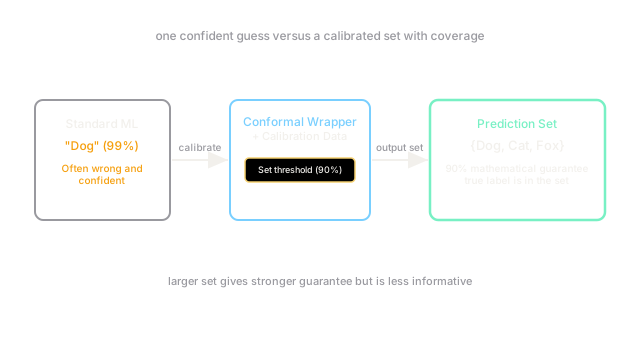
The Problem
Neural networks are notoriously overconfident. A classifier might look at an image of a dog and predict "cat" with 99% probability. In high-stakes fields like medicine or self-driving cars, a single wrong-but-confident prediction can be fatal. Standard softmax probabilities do not represent true uncertainty. We needed a way to bound a model's predictions with rigorous confidence intervals (e.g., "I am 95% sure the answer is in this specific set of options"), regardless of how complex or black-box the model was.
The Idea
The authors popularized Conformal Prediction, an elegant, distribution-free mathematical framework that wraps around any pre-trained model. Instead of predicting a single point (or a single class), it predicts a set. It uses a small, held-out calibration dataset to measure the model's past mistakes. Based on those mistakes, it calculates a "conformal score." For any new prediction, it outputs a range (for regression) or a set of classes (for classification) that is mathematically guaranteed to contain the true answer with a user-specified probability (like 90%).
How It Works
The basic pipeline for classification (Split Conformal Prediction):
- Calibration: Take a pre-trained model and run it on a small, labeled calibration dataset (data it didn't see during training).
- Scoring: For every image, calculate a "non-conformity score." If the model is confident in the wrong answer, the score is high.
- Calculate the Threshold: Sort all the scores. If you want a 90% guarantee, find the score at the 90th percentile (the threshold ).
- Inference: For a new, unseen image, the model outputs probabilities for all classes. The conformal wrapper includes every class whose probability is above the calculated threshold . The resulting set might contain 1 item (if the model is very sure) or 5 items (if the image is ambiguous), but it will contain the true answer 90% of the time.
Why It Mattered
Conformal prediction bridged the gap between deep learning and rigorous statistical safety. It allowed regulators and doctors to trust black-box models because the uncertainty quantification was mathematically guaranteed, regardless of whether the model was a simple linear regression or a massive neural network.
What Came After
Conformal prediction became a massive area of research, expanding beyond classification to object detection, natural language generation, and time-series forecasting. It is now a standard requirement for deploying AI in critical healthcare diagnostics.