Paper breakdown
Claude 3
The 2024 Anthropic paper detailing a family of models that pushed the frontier of AI capabilities, heavily utilizing Constitutional AI and Constitutional alignment.
The Problem
Standard Reinforcement Learning from Human Feedback (RLHF) has major scaling issues. It requires tens of thousands of human contractors to constantly read AI outputs and vote on which is better. Humans are slow, expensive, and inconsistent (especially when judging complex coding or legal tasks). Anthropic realized that to align models faster and better, they needed to automate the feedback loop.
The Idea
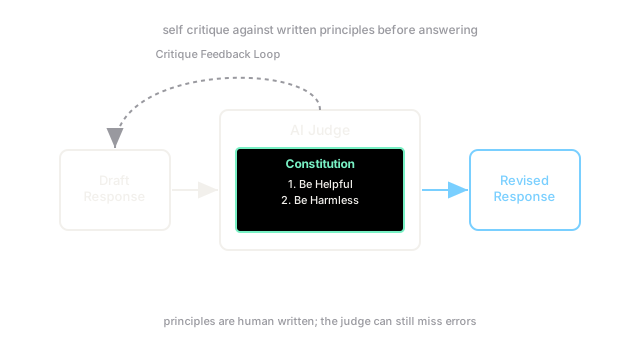
Anthropic pioneered "Constitutional AI." Instead of humans rating outputs, humans write a "Constitution"—a list of specific principles and rules (e.g., "Choose the response that is less harmful," "Choose the response that is more objective"). The AI itself is then prompted to evaluate its own outputs against this constitution, and revise them. This synthetic feedback is used to train the reward model and guide the RL process (RLAIF - Reinforcement Learning from AI Feedback).
How It Works
The Constitutional AI pipeline (the backbone of Claude 3):
- Supervised Phase: The model generates responses to potentially harmful prompts. It is then shown a principle from the Constitution and asked to critique its own response. It rewrites the response to conform to the principle. The model is fine-tuned on these self-revised responses.
- RL Phase: The model generates two responses to a prompt. A separate AI model (acting as the judge) reads the Constitution and decides which response adheres better to the principles. This AI feedback is used to train the Reward Model, which then optimizes the main model via Reinforcement Learning.
The Claude 3 family was released in three tiers:
- Haiku: Fastest and cheapest, optimized for latency.
- Sonnet: The balanced workhorse model.
- Opus: The massive, frontier model designed for complex reasoning.
Why It Mattered
Claude 3 Opus briefly dethroned GPT-4 on major benchmarks, proving that Anthropic's alignment and scaling techniques were world-class. More importantly, Constitutional AI proved that high-quality alignment could be automated, solving the human-data bottleneck and making models far more "steerable" simply by editing a text file (the Constitution).
What Came After
Anthropic quickly followed up with Claude 3.5 Sonnet, which drastically improved coding and reasoning speeds, cementing Claude as the preferred model for software engineers. The RLAIF methodology became a standard tool used by all frontier labs to generate synthetic alignment data.