Paper breakdown
Double/Debiased ML
The 2016 economics and statistics paper that proved how to use highly flexible machine learning models to infer true causal effects, without bias.
Paper: Double/Debiased Machine Learning for Treatment and Structural Parameters
Authors: Victor Chernozhukov, Denis Chetverikov, Mert Demirer, Esther Duflo, Christian Hansen, Whitney Newey, James Robins · 2016
Read the paper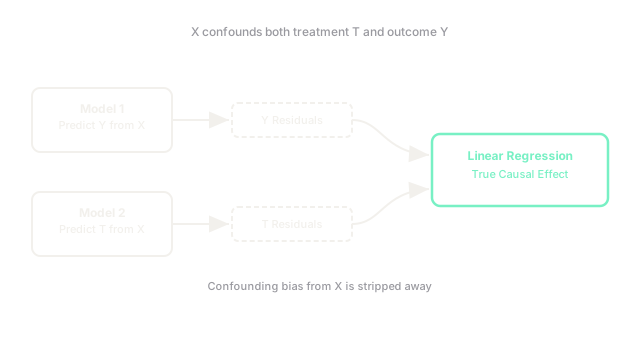
The Problem
Machine learning models (like Random Forests or Neural Networks) are incredible at prediction (finding correlations). However, in many fields (like medicine or economics), we care about causation. (e.g., "Did this drug cause a drop in blood pressure, or is it just correlated with wealthy patients who eat healthier?"). If you naively throw a massive Random Forest at a dataset to estimate the causal effect of a treatment, the estimate will be mathematically biased. The model's complex regularization (which makes it good at prediction) fundamentally breaks traditional causal inference math, shrinking the causal estimate towards zero.
The Idea
The authors (including Nobel laureate Esther Duflo) introduced Double/Debiased Machine Learning (DML). It allows researchers to use highly complex, flexible ML models to control for hundreds of confounding variables (which traditional linear regression can't handle), while mathematically "de-biasing" the final causal estimate. It relies on a specific statistical structure (Neyman Orthogonality) and a technique called "cross-fitting."
How It Works
To find the true effect of a Treatment () on an Outcome (), controlling for many Confounders ():
- Cross-fitting: Split the data into two halves. Train models on half, predict on the other half. This prevents the ML model from overfitting and biasing the causal estimate.
- Model 1 (Predict Y): Train a powerful ML model to predict the Outcome () using only the Confounders (). Calculate the residuals (the part of unexplained by ).
- Model 2 (Predict T): Train a second ML model to predict the Treatment () using only the Confounders (). Calculate the residuals (the part of unexplained by ).
- The Causal Step: Regress the residuals of on the residuals of . Because both variables have had the confounding influence of mathematically stripped away by the ML models, this final simple regression gives the true, unbiased causal effect of on .
Why It Mattered
DML bridged the gap between modern AI and classical econometrics/causal inference. It allowed tech companies (like Uber or Amazon) to run complex observational studies (e.g., "What is the true effect of this pricing change?") using thousands of variables, without having to run expensive randomized A/B tests.
What Came After
DML became the foundational algorithm for causal AI libraries (like Microsoft's EconML and Uber's CausalML). It sparked a massive subfield combining causal inference with deep learning to handle high-dimensional confounding data like text and images.