DreamBooth
A method to personalize text-to-image diffusion models using just 3-5 images, binding a specific subject to a rare token while preserving class prior.
Paper: DreamBooth: Fine Tuning Text-to-Image Diffusion Models for Subject-Driven Generation
Authors: Nataniel Ruiz, Yuanzhen Li, Varun Jampani, Yael Pritch, Michael Rubinstein, Kfir Aberman · 2022
Read the paper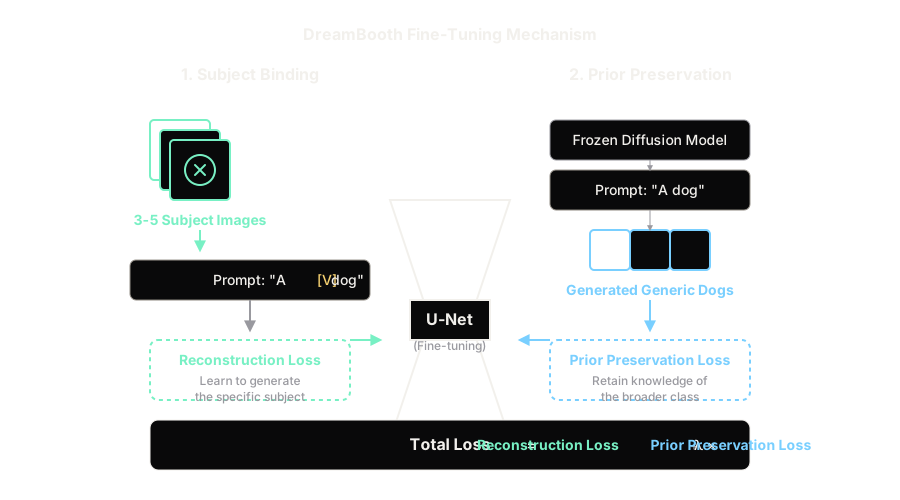
The Problem
Standard text-to-image diffusion models excel at generating high-quality images from text prompts, but they lacked a way to synthesize images of a specific user-provided subject in novel contexts. If you wanted the model to generate your exact dog, providing a text description wasn't enough to capture its unique visual identity. Existing approaches either required massive datasets to train entirely new concepts or struggled to preserve the subject's exact identity while fundamentally altering the surrounding scene.
The Idea
DreamBooth introduces a technique to "implant" a unique subject into the output domain of a pretrained diffusion model using only 3-5 images. It binds the subject to a rare token identifier combined with a semantic class noun (e.g., "a [V] dog") during a brief fine-tuning phase. To prevent the model from forgetting how to generate general instances of the class—or overfitting to the small dataset—it simultaneously uses a prior-preservation loss that forces the model to retain its original, broader knowledge of the target class.
How It Works
Rare-Token Binding
The method begins by selecting a rare, unique identifier token (represented as [V]) that has a very weak prior meaning in the model's text vocabulary. This token is combined with a general class noun that loosely describes the subject, creating a prompt like "a [V] dog". The diffusion model is then fine-tuned on the few provided images of the specific subject paired with this prompt. By leveraging the class noun, the model rapidly anchors the new concept within its existing prior knowledge of what a "dog" should look like, while the rare token specifically binds to the fine details of the subject's identity.
Prior Preservation Loss Fine-tuning a massive generative model on just 3-5 images typically leads to language drift—where the model forgets what the class noun originally meant—and reduced diversity, where it only generates the subject in the exact poses from the training set. DreamBooth solves this by training on two streams of data simultaneously:
- The few-shot images of the specific subject, conditioned on "a [V] dog".
- Images of generic dogs generated dynamically by the frozen original model, conditioned simply on "a dog".
The loss function regularizes the network by penalizing the model if its output for generic "dog" prompts deviates from its own prior knowledge. This elegant trick ensures the fine-tuned model can still synthesize diverse scenes and variations while faithfully and accurately reproducing the specific subject in novel contexts.
Why It Mattered
DreamBooth democratized highly personalized image generation. It proved conclusively that large diffusion priors could be efficiently adapted to specific subjects without catastrophic forgetting or the need for large-scale data collection. This unlocked intense community interest in customized AI generation, leading to widespread tools and consumer applications for creating custom avatars, product mockups, and stylized portraits based on just a handful of personal photos.
What Came After
DreamBooth heavily influenced the rapidly expanding personalized generation ecosystem. While the original method required fine-tuning the entire model (which was storage-intensive), the open-source community quickly combined it with parameter-efficient methods like LoRA to make personalizing Stable Diffusion incredibly cheap, accessible, and fast. It also directly inspired zero-shot personalization architectures and spatial conditioning models like ControlNet, completely transforming how users exert exact, targeted control over generative outputs.