Paper breakdown
Emergent Abilities of LLMs
Argued that certain complex capabilities in LLMs appear suddenly and unpredictably only after the model crosses a specific scale threshold, becoming a central tenet of the AI scaling hypothesis.
Paper: Emergent Abilities of Large Language Models
Authors: Jason Wei, Yi Tay, Rishi Bommasani, Colin Raffel, Barret Zoph, Sebastian Borgeaud, Dani Yogatama, Maarten Bosma, Denny Zhou, Donald Metzler, Ed H. Chi, Tatsunori Hashimoto, Oriol Vinyals, Percy Liang, Jeff Dean, William Fedus · 2022
Read the paper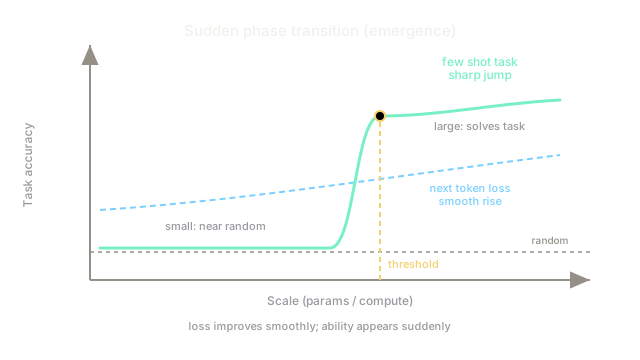
The Problem
Since the Kaplan scaling laws (2020), it was known that the base cross-entropy loss of a language model improves smoothly and predictably as the model is scaled up.
However, cross-entropy loss is just a mathematical measure of next-word prediction accuracy. It doesn't tell us much about actual downstream capabilities. When researchers tested models of various sizes on complex reasoning tasks (like multi-step arithmetic, logic puzzles, or translation), the performance improvements did not look smooth. They needed to understand if capabilities scaled predictably with loss, or if something else was happening.
The Idea
The massive multi-institutional team (spanning Google, DeepMind, and Stanford) aggregated data from dozens of models evaluated on hundreds of benchmarks.
They proposed the concept of Emergent Abilities. Borrowing from physics and biology, they defined an emergent ability as a capability that is "not present in smaller models but is present in larger models." Crucially, they argued that these abilities do not grow linearly; they appear suddenly, like a phase transition, only after the model crosses a specific threshold of compute or parameters (often around 10B to 100B parameters).
How It Works
The paper is an empirical meta-analysis. They plotted model accuracy on the y-axis and model compute/parameters (on a log scale) on the x-axis for various tasks.
For many complex tasks, the graphs looked flat. A 1M parameter model scored 0%. A 1B parameter model scored 0%. A 10B parameter model scored 0%. But suddenly, at 50B parameters, the accuracy spiked vertically to 40%, and continued growing rapidly thereafter.
The authors concluded that as models get larger, they don't just get incrementally better at things they already know; they spontaneously unlock entirely new cognitive capabilities that were impossible to predict by looking at the smaller models.
Why It Mattered
This paper had a profound impact on AI philosophy, investment, and safety.
For investors and researchers, it served as the ultimate justification for building massive supercomputers. If a $100 million cluster didn't solve a problem, the emergence hypothesis suggested that a $1 billion cluster might suddenly unlock the solution.
For AI safety researchers, it was terrifying. If capabilities emerge suddenly and unpredictably at scale, a future model might suddenly "wake up" with the ability to write dangerous malware or deceive its creators, with no warning signs in the smaller testing models.
What Came After
The concept of emergence became the dominant narrative in AI for over a year. However, it was soon heavily criticized and directly rebutted by the paper "Are Emergent Abilities of Large Language Models a Mirage?" (2023), which argued that the "sudden" appearance of these abilities was merely an illusion caused by how researchers chose to measure them. This set up one of the most famous theoretical debates in modern AI.