GloVe
Introduced GloVe, an unsupervised algorithm that learns dense word vectors by factoring a global word-word co-occurrence matrix, combining matrix factorization and local context windows.
Paper: GloVe: Global Vectors for Word Representation
Authors: Jeffrey Pennington, Richard Socher, Christopher D. Manning · 2014
Read the paper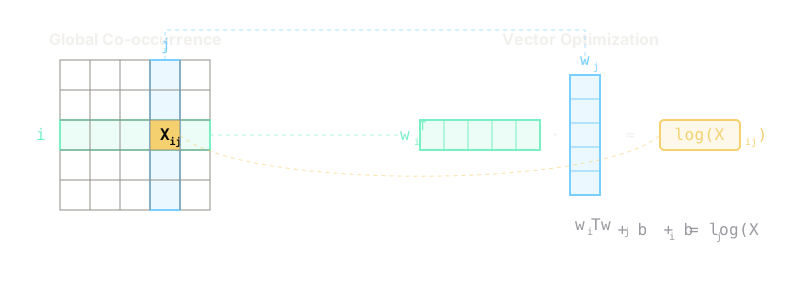
The Problem
While Word2Vec demonstrated that word embeddings could capture rich semantic and analogical relationships using local context windows, it operated somewhat opaquely. Conversely, older statistical methods like Latent Semantic Analysis (LSA) relied on global matrix factorization (analyzing a word-document co-occurrence matrix). Matrix factorization leveraged global statistical information efficiently but performed poorly on word analogy tasks. The field was split: local context window models captured meaning well but ignored global statistics, while global matrix models captured global statistics but struggled with meaningful vector analogies.
The Idea
The authors of GloVe (Global Vectors) argued that a word-word co-occurrence matrix already contains all the necessary statistical information to learn meaningful vector representations. By factoring a globally constructed co-occurrence matrix — but specifically optimizing the model to preserve the ratios of co-occurrence probabilities rather than raw counts — they could capture the exact same geometric semantic relationships as Word2Vec. GloVe combined the structural benefits of global matrix factorization with the semantic richness of local context window models.
How It Works
The GloVe mechanism can be broken down into two main phases:
Building the Matrix First, the algorithm passes through the entire training corpus to construct a massive global word-word co-occurrence matrix. Each cell represents how many times a given word appears in the context of another word within a specific window size.
Optimizing the Vectors Rather than predicting context words directly (as in Word2Vec), GloVe defines a loss function that explicitly forces the dot product of two word vectors to equal the logarithm of their co-occurrence probability. The model minimizes a weighted least squares objective function. The weighting function is crucial: it prevents rare words from having too little impact and caps the influence of extremely frequent words (like "the" or "and").
Because the optimization only happens over the non-zero elements in the global matrix (rather than iterating through every single word in the corpus sequentially over many epochs like a sliding window), training is computationally efficient, especially on large corpora.
Why It Mattered
GloVe achieved state-of-the-art results across standard word analogy, word similarity, and Named Entity Recognition (NER) tasks when it was released. Crucially, it provided a more mathematically interpretable framework for word embeddings than the purely neural Word2Vec. It proved that word analogies (King - Man + Woman = Queen) emerge organically from the log-bilinear model of co-occurrence probabilities.
What Came After
Alongside Word2Vec and fastText, GloVe became the standard off-the-shelf embedding layer for virtually all deep learning NLP models prior to the Transformer era. Pre-trained GloVe vectors (trained on massive Common Crawl, Wikipedia, and Twitter datasets) were downloaded and slotted into recurrent neural networks (RNNs and LSTMs) worldwide. Eventually, static embeddings like GloVe were superseded by contextualized embeddings from models like ELMo and BERT, which assign different vectors to the same word depending on its surrounding context.