ImageBind: One Embedding Space To Bind Them All
Learns a single joint embedding space for six different modalities using image-paired data, enabling emergent cross-modal alignment without explicit pairing.
Paper: ImageBind: One Embedding Space To Bind Them All
Authors: Rohit Girdhar, Alaaeldin El-Nouby, Zhuang Liu, Mannat Singh, Kalyan Vasudev Alwala, Armand Joulin, Ishan Misra · 2023
Read the paper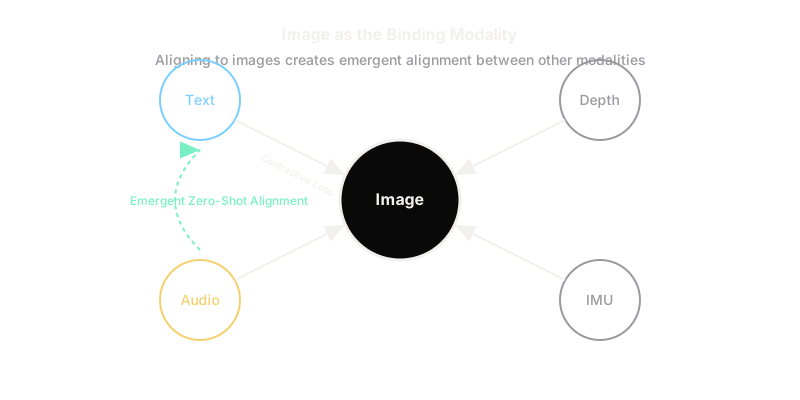
The Problem
Humans naturally bind different senses together. We know what a "dog" looks like, sounds like, and what the word means. In AI, learning a joint embedding space typically required explicit paired data for every combination of modalities (e.g., text-audio pairs, audio-image pairs, depth-image pairs). Collecting large-scale, high-quality paired data for every possible combination (an problem for modalities) is practically impossible.
The Idea
ImageBind sidesteps the pairing problem by treating the image as the binding modality. Because images are naturally co-occurring with many other modalities (images have text captions, video has audio, 3D scans have depth, wearable cameras have IMU motion data), the authors proposed training individual encoders for six modalities and aligning them all to the image embedding space using contrastive learning.
Crucially, they discovered that binding modality to images and modality to images caused modality and to become aligned with each other automatically—an emergent zero-shot alignment.
How It Works
The Modalities ImageBind links six modalities: Images/Video, Text, Audio, Depth, Thermal, and IMU (motion).
The Architecture and Training
- Independent Encoders: Each modality has its own specialized encoder (e.g., a ViT for images, a 1D convolution + Transformer for IMU, an AudioMAE for audio).
- Shared Image Space: During training, the image encoder's weights are kept frozen (it is initialized from a powerful pre-trained vision-language model).
- Contrastive Alignment: The model is trained on pairs of (Image, Modality X). A contrastive loss (InfoNCE) forces the embedding of Modality X to be close to the embedding of its paired Image, and far from the embeddings of other images in the batch.
- Emergent Binding: The model is never explicitly trained on (Audio, Text) pairs. However, because the text "dog barking" is aligned to the image of a barking dog, and the audio of a bark is aligned to that same image, the audio embedding and the text embedding naturally end up close together in the shared space.
Why It Mattered
ImageBind demonstrated that you don't need exhaustive pairwise datasets to build truly multimodal AI. It enabled a host of zero-shot capabilities out of the box, such as:
- Audio-to-Image Generation: Generating an image based on a sound (using the audio embedding as a prompt for a diffusion model).
- Cross-modal Retrieval: Searching for audio clips using a text prompt, or searching for images using an IMU motion pattern.
- Embedding Arithmetic: Adding embeddings across modalities (e.g., Image of a beach + Audio of birds chirping = Retrieved image of seagulls at a beach).
What Came After
ImageBind laid the conceptual groundwork for "any-to-any" multimodal models. It proved that vision is a sufficiently rich and central modality to anchor all other physical and linguistic modalities, heavily influencing the design of subsequent open-source and proprietary multimodal large language models (MLLMs).