Paper breakdown
Language Models are Unsupervised Multitask Learners
The paper introducing GPT-2, demonstrating that scaling up a language model allows it to perform various downstream tasks zero-shot without explicit fine-tuning.
Paper: Language Models are Unsupervised Multitask Learners
Authors: Alec Radford, Jeffrey Wu, Rewon Child, David Luan, Dario Amodei, Ilya Sutskever · 2019
Read the paper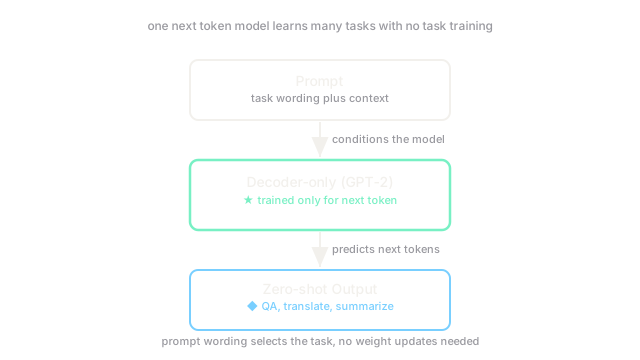
The Problem
Machine learning systems historically required massive datasets of explicitly labeled examples for every specific task (e.g., thousands of labeled translations to learn translation). The field was highly fragmented, with researchers building specialized architectures and collecting specialized datasets for individual tasks. The reliance on supervised learning created a massive bottleneck for AI capability and generality.
The Idea
OpenAI researchers hypothesized that language contains all the implicit supervision a model needs. A sufficiently large language model, trained purely to predict the next word on a diverse enough dataset, should naturally learn to perform various tasks—like translation, summarization, and reading comprehension—just to get better at predicting the next word.
The core idea was that language modeling is essentially unsupervised multitask learning. If the model is large enough, you don't need to fine-tune it on task-specific data; you can simply prompt it with the task description, and it will execute it zero-shot.
How It Works
The architecture of GPT-2 is a decoder-only Transformer, very similar to the original GPT-1 but scaled up significantly (up to 1.5 billion parameters).
The primary contribution was not architectural, but empirical. The team created a massive new dataset called WebText (millions of web pages scraped from outbound Reddit links) to ensure the model saw highly diverse, high-quality human text.
When evaluated, instead of fine-tuning the model, they evaluated its zero-shot performance. For example, to test translation, they would prompt the model with `English text = French text` pairs and ask it to complete the pattern.
Why It Mattered
GPT-2 was a revelation. It proved that the representation capacity of language models scaled predictably with size, and that zero-shot capabilities naturally emerge at scale. It was the first model to generate highly coherent, multi-paragraph text that felt eerily human.
It also marked the beginning of AI safety concerns regarding generative text; OpenAI famously (and controversially) delayed the release of the largest 1.5B model out of fear it could be used to generate convincing fake news and spam at scale.
What Came After
GPT-2 proved the scaling hypothesis, paving the exact path for GPT-3 (2020), which scaled the same concept up by 100x (to 175 billion parameters) and introduced the formal concept of in-context learning. The decoder-only architecture has since completely superseded other approaches for general-purpose LLMs, becoming the de facto standard for everything from ChatGPT to Llama.