Model-Agnostic Meta-Learning (MAML)
Introduced MAML, a meta-learning algorithm that explicitly trains a model's initial parameters so that a few gradient steps on a new task produce maximal performance.
Paper: Model-Agnostic Meta-Learning for Fast Adaptation of Deep Networks
Authors: Chelsea Finn, Pieter Abbeel, Sergey Levine · 2017
Read the paper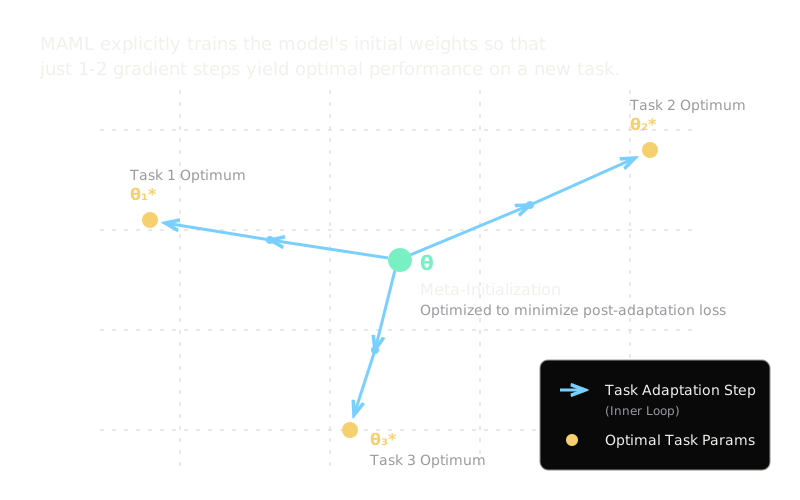
The Problem
Standard deep learning trains a single model for a single task using vast amounts of data. If you want a model to learn a new task from only a few examples (few-shot learning), standard gradient descent fails—it will either violently overfit to those few examples or barely change at all. Prior attempts to solve this usually involved creating specialized, complex neural network architectures (like Memory-Augmented Neural Networks) or using metric-learning approaches tailored to specific domains like image classification. There wasn't a general, architecture-independent way to train a network specifically for fast adaptation.
The Idea
Instead of training a model to perform well on a single task, MAML trains the model's initialization so that it can rapidly learn any new task.
Finn and colleagues realized that a good meta-learning model isn't one whose weights are already perfect for a given task, but one whose weights are highly sensitive to the loss functions of a distribution of tasks. They framed meta-learning as finding a central, "golden" initialization point in the parameter space. From this point, just one or two steps of standard gradient descent using a few examples of a new task will snap the model directly to the optimal parameters for that task.
How It Works
MAML operates using two nested loops of training, often called the inner loop and the outer loop.
The Inner Loop (Task-Specific Adaptation) During training, the algorithm samples a batch of different tasks. For a single task, the model is given a small support set of examples. It takes one or a few standard gradient descent steps on this support set to compute adapted parameters. This simulates what the model would do at test time when given a new, few-shot task.
The Outer Loop (Meta-Optimization) After adapting the parameters for each task in the batch, MAML evaluates these adapted models on a held-out query set for their respective tasks. It then calculates the meta-gradient: how the original initialization parameters should change to make those post-adaptation losses smaller. Crucially, this requires computing second-order derivatives (gradients of gradients), because the adaptation step itself involved a gradient update. The original weights are then moved in the direction that optimizes the post-adaptation performance across all tasks in the batch.
Because MAML only relies on standard gradient descent, it is completely agnostic to the model architecture and the loss function. It can be applied to classification, regression, or reinforcement learning policies without modification.
Why It Mattered
MAML proved that you didn't need specialized "meta-learning" network architectures (like recurrent memory modules) to achieve state-of-the-art few-shot learning. By simply forcing the model to explicitly optimize for rapid adaptation during training, standard feedforward and convolutional networks could become incredibly adept at learning from sparse data.
What Came After
MAML sparked an entire subfield of optimization-based meta-learning. It led to First-Order MAML (FOMAML), which dropped the expensive second-order derivatives while maintaining most of the performance, and Reptile, a related algorithm from OpenAI that further simplified the math. MAML remains one of the most cited baselines for any new research in few-shot classification and fast-adapting reinforcement learning agents.