Paper breakdown
Model Cards
The 2018 paper that established the industry standard for AI transparency, proposing that every machine learning model should be accompanied by a 'nutrition label' detailing its performance, limits, and biases.
Paper: Model Cards for Model Reporting
Authors: Margaret Mitchell, Simone Wu, Andrew Zaldivar, Parker Barnes, Lucy Vasserman, Ben Hutchinson, Elena Spitzer, Inioluwa Deborah Raji, Timnit Gebru · 2018
Read the paper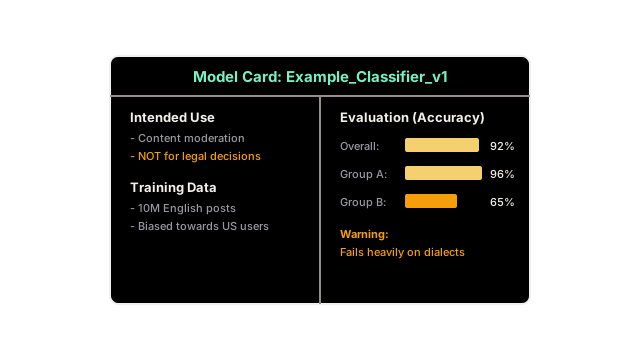
The Problem
By 2018, machine learning models were being rapidly deployed in high-stakes areas like facial recognition, loan approvals, and hiring. However, these models were sold or open-sourced as black boxes. A developer downloading a sentiment analysis model had no idea what data it was trained on, what biases it held, or in what specific scenarios it was known to fail. When facial recognition models were proven to have significantly higher error rates for darker-skinned females, the industry realized it desperately needed a standardized framework for transparency.
The Idea
Google researchers (co-led by Timnit Gebru and Margaret Mitchell) proposed "Model Cards." Similar to a nutrition label on food or a spec sheet for a hardware component, a Model Card is a standardized, short document that accompanies a trained machine learning model. It explicitly defines the model's intended use cases, its known limitations, and most importantly, its performance evaluated not just as an overall average, but broken down across different cultural, demographic, or phenotypic groups.
How It Works
A standard Model Card includes:
- Model Details: Architecture, version, date, and developer contact info.
- Intended Use: Who should use it and for what? (e.g., "Entertainment purposes only, not medical diagnosis").
- Metrics: Which performance metrics were chosen and why?
- Training & Evaluation Data: What data was used, and how was it split?
- Quantitative Analyses: Intersectional evaluation. (e.g., Accuracy is 99% for Group A, but only 72% for Group B).
- Ethical Considerations: Known risks, potential harms, and mitigations.
Why It Mattered
Model Cards shifted the AI industry's focus from pure performance metrics to holistic accountability. It forced developers to actively look for and document their model's flaws before release.
What Came After
Model Cards became universally adopted. Hugging Face built their entire platform around the concept, requiring a Model Card (README.md) for every model uploaded to their hub. Governments and regulatory bodies (like the EU AI Act) have since incorporated the principles of Model Cards into legal compliance requirements for high-risk AI systems.