OWL-ViT: Vision Transformer for Open-World Localization
Adapts standard Vision Transformers into zero-shot object detectors by attaching light prediction heads and scaling pre-training on image-text pairs.
Paper: Simple Open-Vocabulary Object Detection with Vision Transformers
Authors: Matthias Minderer, Alexey Gritsenko, Austin Stone, Maxim Neumann, Dirk Weissenborn, Alexey Dosovitskiy, Aravindh Mahendran, Anurag Arnab, Mostafa Dehghani, Zhuoran Shen, Xiao Wang, Xiaohua Zhai, Thomas Kipf, Neil Houlsby · 2022
Read the paper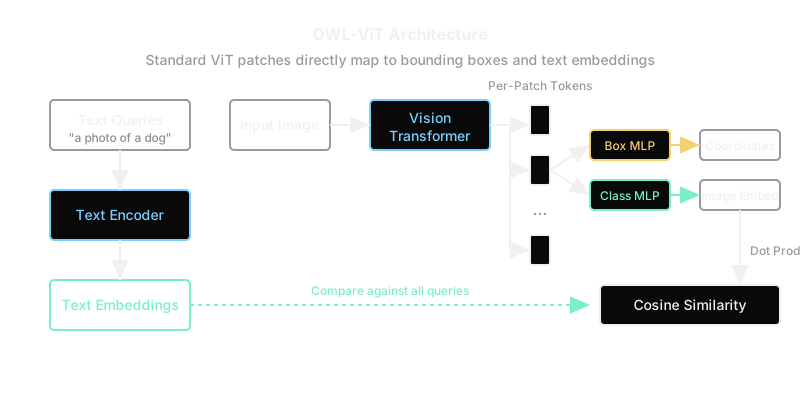
The Problem
By 2022, models like CLIP had proved that large-scale contrastive pre-training on image-text pairs yielded powerful zero-shot image classifiers. However, using these models for detection—finding boxes for arbitrary text queries—was difficult. Previous open-vocabulary detectors usually relied on complex, multi-stage pipelines (like Mask R-CNN or DETR architectures) that were difficult to train, heavily engineered, and didn't easily scale to the massive datasets required for true open-world robustness.
The Idea
The OWL-ViT (Open-World Localization with Vision Transformers) paper asked a simple question: Can we just take a standard CLIP model and turn it into a zero-shot detector with minimal architectural changes? The authors showed that by simply removing the final pooling layer of a Vision Transformer (ViT) and attaching a few lightweight, linear projection heads to the individual image patches, they could transform a standard image-level model into a dense, open-vocabulary object detector.
How It Works
1. Contrastive Pre-training (CLIP-style) The model begins as a standard dual-encoder architecture (an image ViT and a text Transformer), pre-trained via contrastive learning on massive image-text pairs. At this stage, it's just a zero-shot classifier.
2. Removing the Bottleneck
Normally, a ViT aggregates all its spatial patches into a single [CLS] token to classify the whole image. OWL-ViT discards this pooling step. Instead, it treats every single patch token in the final layer as a potential object proposal.
3. Lightweight Prediction Heads To each patch token, OWL-ViT attaches two simple, shallow multi-layer perceptrons (MLPs):
- Box Head: Predicts the bounding box coordinates (center, width, height) relative to that patch.
- Class Head: Predicts the class embedding for the object in that box.
4. Bipartite Matching Fine-tuning The model is then fine-tuned on standard detection datasets (like COCO or Objects365). The predicted class embeddings are compared against the text embeddings of the target labels using dot products. Because the architecture remains almost entirely identical to the original CLIP model, this fine-tuning preserves the rich, open-vocabulary semantic space learned during the massive image-text pre-training phase.
Why It Mattered
OWL-ViT proved that open-vocabulary object detection doesn't require bespoke, heavily engineered architectures. A standard Vision Transformer with simple linear heads is sufficient, provided the pre-training scale is large enough. It radically simplified the detection pipeline and provided a strong baseline for zero-shot object localization.
What Came After
OWL-ViT helped establish the paradigm of "minimal architectural intervention" when adapting foundation models to dense prediction tasks. It paved the way for subsequent models (like OWL-v2) that scaled this approach further, and its simplicity made it a popular choice for practical applications requiring zero-shot detection.