ResNeXt
Introduced cardinality as a new dimension for scaling neural networks, splitting convolutions into parallel grouped pathways.
Paper: Aggregated Residual Transformations for Deep Neural Networks
Authors: Saining Xie, Ross Girshick, Piotr Dollár, Zhuowen Tu, Kaiming He · 2017
Read the paper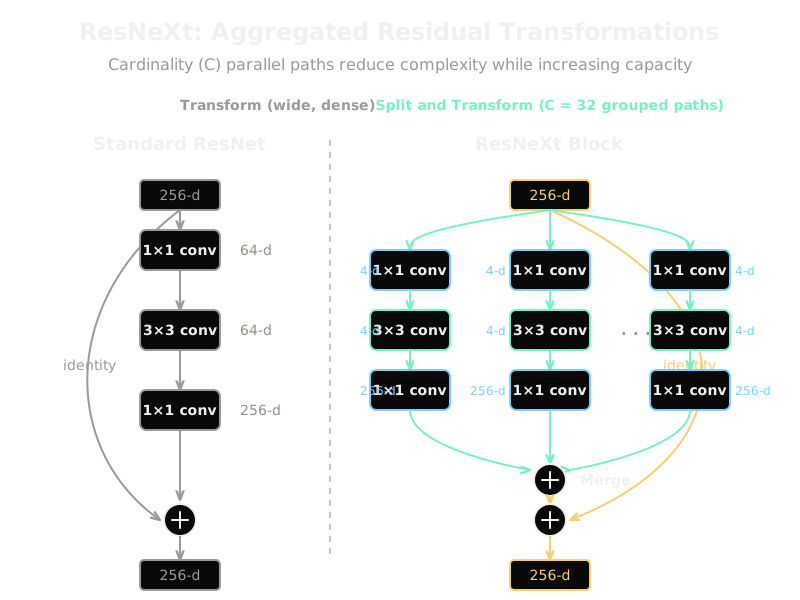
The Problem
After ResNet proved that depth allowed networks to learn more complex features, and Wide ResNets showed that width (number of channels) also improved performance, the standard way to scale up a network was to just make it deeper or wider. However, both approaches suffered from diminishing returns. Increasing depth led to optimization difficulties, and increasing width caused the parameter count and computational cost to explode quadratically. The field needed a more efficient way to increase a model's capacity without indiscriminately stacking layers or widening channels.
The Idea
The authors looked at the Inception architecture, which successfully used a "split-transform-merge" strategy (splitting input into different branches, applying different filters, and concatenating the results). But Inception blocks were notoriously complex, requiring careful manual tuning of filter sizes and channel numbers for every branch.
ResNeXt proposed combining the elegant simplicity of ResNets with the split-transform-merge strategy of Inception. Instead of meticulously designing different branches, ResNeXt splits the input into many identical parallel branches. The number of these parallel branches is a new architectural dimension they called cardinality.
How It Works
Instead of a standard residual block where a single wide convolution is applied, ResNeXt uses a grouped convolution approach to apply transformations:
Split The input channels are split into groups, where is the cardinality (typically set to 32).
Transform Each of the groups undergoes an identical set of transformations: a 1×1 convolution (to reduce dimensionality), a 3×3 convolution (to process spatial features), and another 1×1 convolution (to restore dimensionality). Because each branch only looks at a small fraction of the total channels (e.g., 4 channels instead of 64), the computational cost per branch is drastically lower.
Merge The outputs of all parallel branches are summed together into a single aggregated output. Finally, just like a standard ResNet, a skip connection adds the original input back to this aggregated output.
By holding the total computational cost (FLOPs) constant, a ResNeXt block can have significantly more total channels than a standard ResNet block because the expensive 3×3 operations are grouped.
Why It Mattered
ResNeXt proved that cardinality (the size of the set of transformations) is a more effective dimension for scaling than depth or width. A network with high cardinality achieved better accuracy than a deeper or wider network with the exact same parameter count and computational complexity. It famously secured 2nd place in the ILSVRC 2016 classification task.
Furthermore, it provided a clean, unified template. By making all parallel paths identical, it eliminated the need for the hyper-parameter tuning that plagued Inception models, proving that split-transform-merge didn't require complex, bespoke topologies to work effectively.
What Came After
Grouped convolutions (the practical implementation of cardinality) became a standard tool for designing efficient architectures. ResNeXt laid the groundwork for future highly efficient models like MobileNet (which takes grouped convolutions to the extreme with depthwise separable convolutions) and ConvNeXt, which modernized the standard CNN architecture using lessons learned from Vision Transformers while retaining the grouped convolution strategy from ResNeXt.