Paper breakdown
Scaling Laws for Neural Language Models
Demonstrated that language model loss decreases predictably as a power law with compute, dataset size, and parameter count, establishing the mathematical foundation for the LLM scaling race.
Paper: Scaling Laws for Neural Language Models
Authors: Jared Kaplan, Sam McCandlish, Tom Henighan, Tom B. Brown, Benjamin Chess, Rewon Child, Scott Gray, Alec Radford, Jeffrey Wu, Dario Amodei · 2020
Read the paper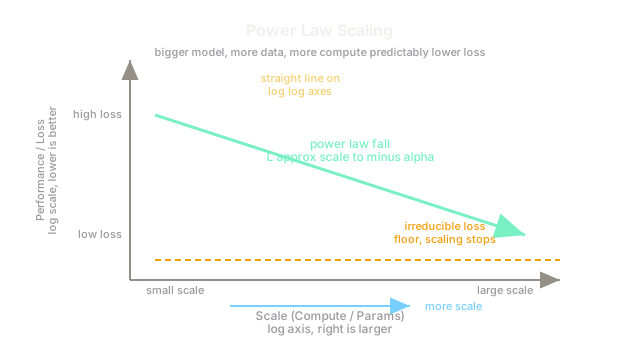
The Problem
Before 2020, training deep learning models was largely alchemy. Researchers would guess architectural hyperparameters, guess how much data was needed, and hope for the best after weeks of training. As models got larger, this trial-and-error approach became unsustainably expensive. No one knew mathematically how much a model would improve if they doubled the compute budget or dataset size.
The Idea
The OpenAI team conducted a massive empirical study to find mathematical laws governing model performance. They trained dozens of language models of varying sizes (from a few thousand to a billion parameters) on varying amounts of data and compute.
They discovered that the cross-entropy loss of a language model is not random; it follows precise, predictable power laws. Model performance depends almost entirely on scale, while architectural details (like depth vs. width) barely matter.
How It Works
The paper establishes three distinct power laws relating the test loss () to:
- Compute (): The total training compute in FLOPs.
- Dataset Size (): The number of tokens trained on.
- Parameters (): The number of non-embedding parameters in the model.
If you plot these relationships on a log-log scale, they form straight lines. This means you can train a small, cheap model, measure its performance, and accurately extrapolate exactly how a massive, expensive model will perform before you even start training it.
The authors also concluded that when scaling up compute budgets, the optimal strategy is to scale up the parameter count () much faster than the dataset size ().
Why It Mattered
This paper ignited the massive LLM scaling race. By proving that larger models yield predictably better performance, they gave executives and investors the mathematical confidence to spend tens of millions of dollars on compute clusters. It transformed AI from an unpredictable research science into a predictable engineering discipline.
What Came After
This paper's specific conclusions about the optimal ratio of parameters to data were critically flawed. Two years later, DeepMind published the Chinchilla paper (Training Compute-Optimal LLMs, 2022), which proved that Kaplan et al. had vastly underweighted the importance of data. DeepMind showed that models and datasets should be scaled equally, totally superseding the scaling coefficients published in this paper. However, the overarching concept of predictable power-law scaling remains the absolute bedrock of modern AI.