Paper breakdown
Support Vector Networks (Cortes & Vapnik)
Formalized the Support Vector Machine (SVM) algorithm for non-linear classification, defining one of the most powerful algorithms of the pre-deep learning era.
The Problem
In the early 1990s, pattern recognition was dominated by neural networks and decision trees. However, these methods often suffered from local minima during optimization and lacked strong theoretical guarantees regarding generalization (how well they perform on unseen data). The "optimal margin classifier" existed for linearly separable data, drawing a perfect boundary between classes, but real-world data is rarely linearly separable. Finding an efficient, theoretically sound way to classify non-linear, messy data was a primary challenge.
The Idea
Cortes and Vapnik introduced the Support Vector Network (now universally known as the Support Vector Machine or SVM). The core idea was to map the input data into a very high-dimensional feature space where the data suddenly becomes linearly separable, and then construct the optimal separating hyperplane in that new space. Crucially, they allowed for "soft margins"—permitting some misclassifications in the training data to prevent overfitting and handle noisy datasets gracefully.
How It Works
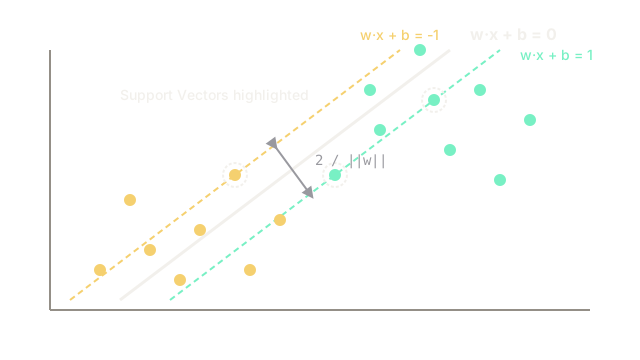
The SVM finds the best line (or hyperplane) separating two classes by maximizing the "margin"—the distance between the hyperplane and the closest data points from either class.
- Support Vectors: The entire boundary is defined solely by a small subset of the training data that lie right on the edge of the margin. These critical points are the "support vectors." The rest of the data can be ignored.
- Soft Margin: A penalty parameter is introduced to allow some points to be on the wrong side of the margin, trading off a wider, more robust margin against perfect training accuracy.
- The Kernel Trick: Instead of explicitly calculating the coordinates of points in the high-dimensional space (which would be computationally impossible), SVMs use kernel functions (like polynomials or Radial Basis Functions). The kernel calculates the inner product of points in the high-dimensional space directly from their original input features, doing the heavy lifting without the computational cost.
Why It Mattered
SVMs fundamentally changed machine learning. They provided a mathematically rigorous, globally optimal algorithm that didn't get stuck in local minima. For over a decade, SVMs were the absolute state-of-the-art for numerous classification tasks, ranging from handwritten digit recognition to text categorization and bioinformatics, often drastically outperforming the neural networks of the time.
What Came After
SVMs dominated the machine learning landscape through the 2000s and drove significant theoretical work in statistical learning theory and kernel methods. While deep learning eventually overtook SVMs in domains like computer vision and natural language processing (due to neural networks' ability to learn hierarchical features from raw data), SVMs remain heavily used today for structured, tabular datasets and tasks where interpretability and theoretical guarantees are prioritized over raw scale.