Textual Inversion
Personalizing text-to-image models by learning a new pseudo-word token embedding to capture a specific subject, keeping the base model completely frozen.
Paper: An Image is Worth One Word: Personalizing Text-to-Image Generation using Textual Inversion
Authors: Rinon Gal, Yuval Alaluf, Yuval Atzmon, Or Patashnik, Amit H. Bermano, Gal Chechik, Daniel Cohen-Or · 2022
Read the paper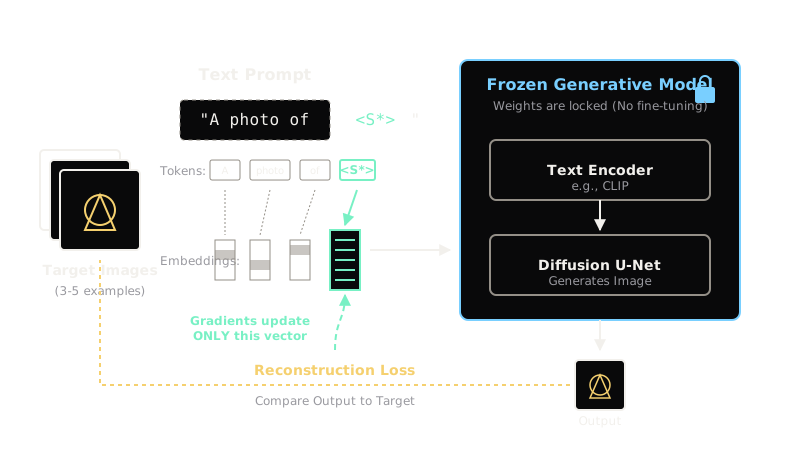
The Problem
Large text-to-image models (like Stable Diffusion) can generate incredible, diverse images from text prompts. However, if a user wants to generate new images of a specific, personal object (like their own dog, or a unique toy), they encounter a roadblock. The model's general vocabulary doesn't know about this specific subject. Prior to Textual Inversion, personalizing a model usually meant fine-tuning the entire network (which is slow, expensive, and risks catastrophic forgetting) or trying to perfectly engineer a very complex prompt to describe the object (which often fails to capture its exact unique details).
The Idea
Instead of fine-tuning the massive image generator model, Textual Inversion proposes adding a new "pseudo-word" to the model's vocabulary and optimizing only the embedding vector for this new word. By showing the model 3-5 images of the specific object and prompting it to reconstruct those images using a placeholder token like A photo of <S*>, the optimization process searches the continuous embedding space for a vector that perfectly represents the object. The base model remains completely unchanged.
How It Works
Textual Inversion leverages the structure of text-conditioned diffusion models, focusing specifically on the text encoding stage.
1. The Placeholder Token
A new, unique string (e.g., <S*>) is introduced. In the text encoder's vocabulary, this token is initialized with an embedding vector (often starting as the embedding for a broad category like "dog" or "toy").
2. Frozen Model Architecture The entire text encoder (typically CLIP) and the image generator (the diffusion U-Net) are completely frozen. Their weights are locked, meaning the core knowledge of the model remains untouched.
3. The Reconstruction Objective
The system is provided with a small set (usually 3-5) of target images of the specific object. The model is trained on a simple reconstruction task: given a prompt like "A photo of <S*>", it must denoise an image back into one of the provided target images.
4. Optimizing the Embedding
During backpropagation, gradients flow all the way through the frozen U-Net and frozen text encoder down to the embedding layer. Since everything else is frozen, only the embedding vector corresponding to <S*> is updated. Over thousands of steps, this single vector is pushed through the embedding space until it captures the visual essence of the target object.
Why It Mattered
Textual Inversion proved that the embedding space of these large models is incredibly rich and expressive. It demonstrated that we don't need to update billions of parameters to teach a model a new concept; sometimes, a single well-optimized word vector is enough. It offered a lightweight, portable way to share concepts—instead of distributing a 4GB model checkpoint, users could share a 4KB embedding file.
What Came After
Textual Inversion kicked off an explosion of research into lightweight personalization for generative models. It directly inspired methods like DreamBooth (which fine-tunes a small portion of the model for higher fidelity) and laid the conceptual groundwork for prompt-tuning and adapter-based approaches like LoRA in the visual domain. It remains a foundational technique for concept injection and model personalization.