Paper breakdown
LIME
The 2016 paper that introduced Local Interpretable Model-agnostic Explanations, a method to figure out exactly why a "black box" AI made a specific decision.
Paper: Why Should I Trust You?: Explaining the Predictions of Any Classifier
Authors: Marco Tulio Ribeiro, Sameer Singh, Carlos Guestrin · 2016
Read the paper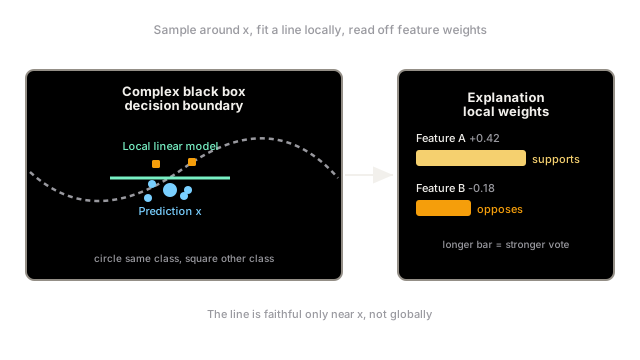
The Problem
As machine learning models transitioned from simple decision trees to deep neural networks and complex ensembles (like Random Forests), they became "black boxes." If a model denied a user a loan, or diagnosed a patient with cancer, humans could not examine the millions of weights to understand why. This lack of interpretability prevented the adoption of AI in healthcare, finance, and the judicial system, where users needed explanations, not just predictions.
The Idea
The authors introduced LIME (Local Interpretable Model-agnostic Explanations). They realized that while an entire neural network is too complex to understand globally, you can approximate its behavior locally. If you want to know why a model classified an image as a "frog," you can perturb the image (hide random patches of pixels) and see how the model's prediction changes. By training a simple, interpretable model (like linear regression) on these perturbed images, you can identify exactly which pixels (or words, or features) caused the model to say "frog."
How It Works
LIME treats the target AI entirely as a black box (it doesn't need to see the weights or gradients):
- Select an instance: Choose the specific prediction you want to explain.
- Perturb the data: Generate thousands of new, slightly altered samples around that instance (e.g., hiding words in a sentence, or graying out superpixels in an image).
- Query the Black Box: Feed these perturbed samples into the complex AI model and record its predictions.
- Train a Local Model: Weight the perturbed samples based on how close they are to the original instance. Train a simple linear model on these weighted samples to predict the black box's output.
- Explain: The weights of this simple linear model directly tell you which features were most important for that specific prediction.
Why It Mattered
LIME was the breakthrough that launched the modern field of Explainable AI (XAI). It proved that you don't need to sacrifice model accuracy for interpretability; you can use the most complex model available and still provide users with a human-readable explanation of why a decision was made.
What Came After
LIME became a standard tool in data science pipelines. It was later joined by SHAP (SHapley Additive exPlanations), which provided a more mathematically rigorous (but computationally heavier) method for assigning feature importance based on game theory.