Trade-off Analysis
On this page
Overview
Trade-off analysis is the core of system design. There is no "perfect" architecture, only the right compromises for a specific set of requirements. Every architectural decision improves one aspect of the system while degrading another (e.g., consistency vs. availability, latency vs. throughput, speed of development vs. operational complexity).
Key Concepts
Common Trade-offs in System Design
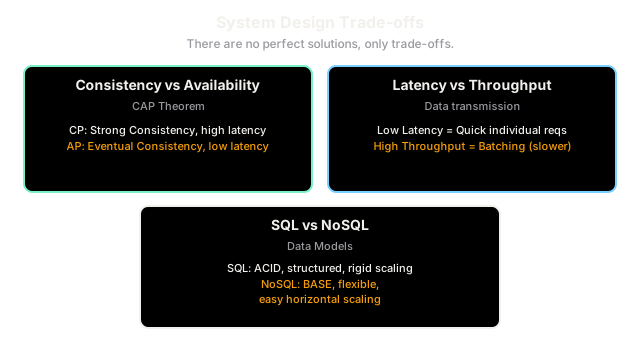
1. Consistency vs. Availability (CAP Theorem)
- Strong Consistency: Every read receives the most recent write. Tradeoff: Higher latency, and the system might reject reads if a node fails (lower availability). (e.g., Financial ledgers).
- Eventual Consistency: Reads might return stale data, but all nodes will eventually converge. Tradeoff: Temporary data mismatch, but highly available and fast. (e.g., Social media likes).
2. Latency vs. Throughput
- Low Latency: Processing requests as fast as possible one by one. (e.g., Real-time gaming).
- High Throughput: Batching requests together to process more data overall in a given time frame. Tradeoff: Batching inherently adds latency to the individual requests. (e.g., Hadoop analytics).
3. Simplicity vs. Scalability (Monolith vs Microservices)
- Monolith: Easy to test, deploy, and reason about. Tradeoff: Hard to scale specific bottlenecks, team contention on one codebase.
- Microservices: Scales beautifully, allows polyglot environments. Tradeoff: Massive operational overhead (networking, tracing, orchestration).
Cost and Engineering Effort
Often overlooked in theoretical designs is the cost of engineering time and cloud bills. Using AWS Spanner might solve your distributed consistency problems flawlessly, but if you are a 3-person startup, the financial cost and learning curve might kill the company before scale is ever an issue. A standard PostgreSQL instance with read replicas is often the correct pragmatic trade-off.
Trade-offs
Every pattern mentioned in system design has a tradeoff. Caching improves read latency but introduces cache invalidation complexity and stale data. Message queues buffer spikes but introduce asynchronous complexity and delayed processing. Sharding allows infinite scale but makes joins impossible and rebalancing a nightmare.
Interview Tips
- Never say "This is the best way." Always say "I am choosing this approach because it optimizes for X, and I am willing to accept the tradeoff of Y given our requirements."
- If the interviewer introduces a new constraint ("What if we expand to Asia?"), don't just add to your design-explain what trade-offs you now need to re-evaluate (e.g., "We will need cross-region replication, which forces us to choose between higher latency for synchronous writes or eventual consistency for asynchronous writes").
Summary
- Trade-off analysis is the justification of why you chose one design over another.
- Every design choice improves one metric (e.g., speed) at the cost of another (e.g., accuracy or complexity).
- CAP theorem dictates the ultimate tradeoff in distributed data: Consistency vs Availability.
- Caching trades data freshness for low latency.
- The ability to articulate the downsides of your own design is the mark of a senior engineer.