Distributed Message Queue
IntermediateOn this page
Overview
A distributed message queue accepts messages from producers, stores them durably, and delivers them to consumers, decoupling the two sides in time and in load. This is a design-a-Kafka question: the defining challenges are durability (never lose an acknowledged message), high throughput (millions of messages per second), horizontal scalability, and configurable ordering and delivery guarantees.
Functional Requirements
- Producers publish messages to a named topic.
- Consumers subscribe to a topic and read messages, individually or as a consumer group that shares the load.
- Messages within a partition are delivered in order.
- Messages are retained for a configurable window (time or size) and can be re-read (replay).
- Support at-least-once delivery, with idempotent/transactional options for stronger guarantees.
Non-Functional Requirements
- Durability: an acknowledged message survives broker crashes (replicated to disk).
- High throughput: millions of messages/sec via horizontal scaling.
- Scalability: add brokers and partitions without downtime.
- Low latency: end-to-end delivery in tens of milliseconds.
- High availability: the cluster tolerates broker failures without data loss.
Capacity Estimation
Assume 1M messages/sec at an average size of 1 KB, retained for 7 days.
- Throughput / bandwidth:
- Ingress: 1M/s x 1 KB = 1 GB/s write.
- With replication factor 3, disk write traffic ~ 3 GB/s across the cluster.
- If each message is read by an average of 3 consumer groups, egress ~ 3 GB/s.
- Storage:
- Per day: 1M/s x 1 KB x 86,400 s = ~86 TB/day.
- Over 7 days: ~86 TB x 7 ~ 600 TB; with replication x3 ~ 1.8 PB.
- Brokers: at ~150 MB/s sustained sequential write per disk and multiple disks per node, on the order of tens of brokers carry the write load; more are added for headroom and replication.
The scale forces partitioning (one topic spans many machines) and cheap sequential disk I/O as the core design driver.
High-Level Architecture
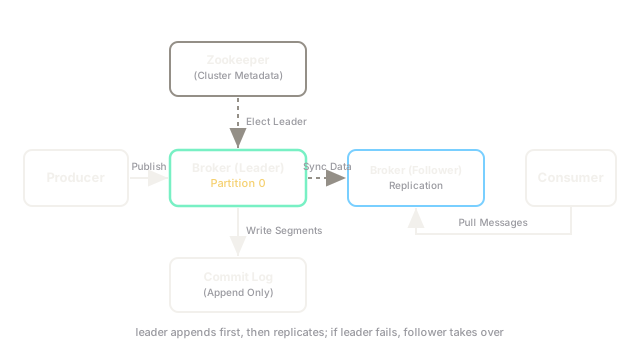
The system consists of Producers that send data, Consumers that read data, and a cluster of Brokers that store it. A Coordination Service (like ZooKeeper or KRaft) manages the metadata, detecting broker failures and electing partition leaders. Topics are divided into partitions, which are distributed across the brokers to parallelize load.
Data Model
| Entity | Fields / Schema | Storage Choice |
|---|---|---|
| topic | name, partition_count, retention, replication_factor | Metadata store (coordination service) |
| partition | topic, partition_id, leader_broker, replica_brokers | Metadata store |
| message | offset (monotonic per partition), key, value, timestamp | Append-only segment files on disk |
| consumer_offset | group_id, topic, partition, committed_offset | Compacted internal topic / KV store |
Detailed Design
The Log is the Core Abstraction
Each partition is an append-only commit log written sequentially to disk - the reason a queue built on cheap disks can outrun many in-memory systems, since sequential I/O and the OS page cache do the heavy lifting. Messages are grouped into segment files; retention deletes whole old segments cheaply.
Partitioning for Scale and Ordering
A topic's partitions spread across brokers so writes and reads parallelize. The producer chooses a partition by hashing the message key (e.g., user_id), which guarantees per-key ordering without needing a global order. Order is guaranteed within a partition, never across partitions - the standard trade-off that makes horizontal scaling possible.
Replication for Durability
Each partition has one leader and N-1 follower replicas on other brokers. Producers write to the leader; followers pull and replicate. The leader tracks the in-sync replica (ISR) set. A producer's acks setting tunes durability vs. latency: acks=1 (leader only, fast, small loss window) or acks=all (all ISR must persist, safe). Leader failover is handled by the coordination service via leader election.
Consumer Groups and Offsets
Consumers in a group divide the partitions among themselves - each partition is read by exactly one consumer in the group, so throughput scales by adding consumers up to the partition count. Each consumer tracks its committed offset; it reads forward and periodically commits progress. Because the broker just serves a byte range from a file and does not track per-message acks, it stays simple and fast.
Bottlenecks & Solutions
The number of partitions is the hard upper limit on consumer parallelism. If a topic has 10 partitions, having 11 consumers in a group means 1 consumer sits idle. However, having too many partitions (e.g., 100,000) degrades cluster performance due to ZooKeeper metadata overhead and the OS having too many open file handles. Network egress is also a common bottleneck if many consumer groups are reading from the same cluster.