Fraud & Anomaly Detection System
AdvancedOn this page
Overview
A Fraud Detection System operates in the high-stakes environment of financial transactions, account takeovers, and payment processing (e.g., Stripe, PayPal, banking). The system must analyze a transaction in milliseconds, compare it against the user's historical behavior and global fraud patterns, and definitively approve or decline the action. It requires a blend of real-time stream processing, Graph Databases to detect fraud rings, and Machine Learning classifiers.
Functional Requirements
- Evaluate incoming financial transactions (or login attempts) and assign a fraud probability score.
- Instantly Block, Allow, or route the transaction for Step-Up Authentication (e.g., 2FA/OTP).
- Detect coordinated fraud rings using linked entities (shared IP, device ID, shipping address).
- Allow human analysts to review flagged transactions in a case management queue.
Non-Functional Requirements
- Ultra-low latency: the entire decision pipeline must complete in < 50-100ms so the user isn't stuck at checkout.
- High availability (99.999%): if the system goes down, payments fail, causing catastrophic revenue loss.
- Explainability: financial regulations often require the system to explain *why* a transaction was blocked.
- Adaptive: fraud patterns shift rapidly; the system must ingest new features and rules in minutes.
Capacity Estimation
Assume a global payment processor handling 10,000 transactions per second (TPS) at peak.
- Latency Budget: 100ms total. 20ms for network overhead, 30ms for Feature Store lookup, 30ms for Graph DB traversal, 20ms for ML inference.
- Feature Store: Extracting sliding window aggregations (e.g., "total amount spent by this card in the last 1 hour") requires 100k+ reads/sec from an in-memory database like Redis.
- Graph Database: Storing billions of edges (User -> Device, Device -> IP, IP -> Transaction) requires a distributed graph database (e.g., TigerGraph or Neo4j) heavily optimized for multi-hop queries.
High-Level Architecture
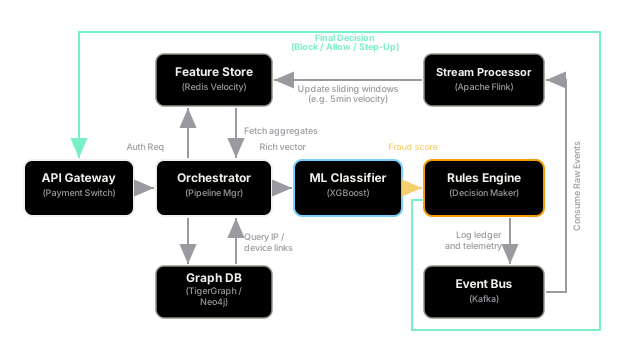
When a transaction arrives at the API Gateway, it routes to the Fraud Orchestrator. The Orchestrator performs parallel data gathering: it fetches historical user features from a Redis Feature Store and queries a Graph Database to check if the device or IP is linked to known bad actors. These features are fed into a fast Machine Learning Model (like XGBoost, due to its speed and tabular data performance). The ML model outputs a fraud score. Finally, a Rules Engine takes the score and business logic (e.g., "If score > 80 AND amount > $5000 -> Block") to make the final decision. The result is returned, and all telemetry is logged asynchronously to a Data Lake via Kafka.
Data Model
| Entity | Fields / Schema | Storage Choice |
|---|---|---|
| real_time_features | user_id (PK), velocity_1h, velocity_24h, distinct_ips_24h | In-Memory Store (Redis / Aerospike) |
| entity_graph | node_id, node_type (User/Device/IP), edges (used_by, logged_in_from) | Graph Database (TigerGraph / Neo4j) |
| transaction_ledger | tx_id, user_id, amount, status, fraud_score, decision_reason | Relational DB (PostgreSQL / CockroachDB) |
Detailed Design
The Role of the Graph Database
Traditional ML struggles to detect "Fraud Rings" (organized groups creating synthetic identities). A Graph Database excels here. When a transaction occurs, the system runs a fast 2-hop or 3-hop query: "Has the device ID associated with this transaction ever been used by an account that was previously marked as fraudulent?" If the graph traversal finds a link, a high-risk boolean feature is passed to the ML model.
Feature Store & Sliding Windows
Fraud models rely heavily on "Velocity Features" (e.g., number of password resets in 10 minutes, amount of money transferred to new payees in 24 hours). A stream processor (Apache Flink) reads raw events from Kafka, continuously calculates these sliding window aggregates, and writes them to the Redis Feature Store. During a transaction, the Orchestrator does an O(1) lookup in Redis to get these pre-computed aggregates.
Explainability vs. Deep Learning
While Deep Learning is popular, fraud systems often prefer Gradient Boosted Trees (XGBoost/LightGBM) or Random Forests. These models handle tabular data exceptionally well, infer very fast on CPUs (no GPU needed), and most importantly, support explainability tools like SHAP values. If regulators ask why a legitimate user's account was frozen, the company can point to the specific features (e.g., "Foreign IP + High Velocity") that triggered the block.
Bottlenecks & Solutions
The primary bottleneck is Stateful Stream Processing. Calculating sliding windows over millions of users requires massive amounts of RAM in Flink to maintain state. If a node fails, state must be restored from checkpoints (RocksDB to S3), which can temporarily halt feature updates. Furthermore, querying the Graph DB under a strict 30ms budget requires carefully restricting traversal depth (e.g., max 3 hops, capped at 100 edges per node) to prevent "super-node" queries from timing out.