Vertical vs Horizontal Scaling
On this page
Overview
Scalability is a system's ability to handle growing load - more users, requests, or data - by adding resources, ideally with a proportional and predictable gain in capacity. A system scales well when roughly doubling its resources roughly doubles the work it can do, without a redesign.
Key Concepts
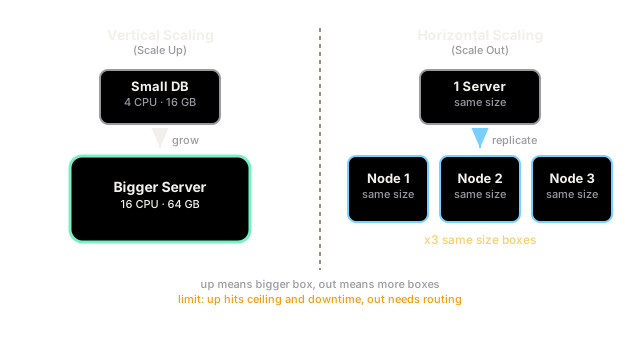
Scaling comes in two fundamental shapes.
- Vertical scaling (scaling up) means making a single machine more powerful: adding CPU cores, RAM, faster disks, or a bigger network card. The application often needs no changes because it still runs as one process on one box.
- Horizontal scaling (scaling out) means adding more machines and spreading the work across them. This is how internet-scale systems grow, but it forces new questions: how requests are distributed, how state is shared, and how partial failures are handled.
Horizontal scaling usually relies on a load balancer to distribute traffic across nodes. On the data tier, growth is absorbed with database replication to scale reads and sharding and partitioning to scale writes and storage.
A closely related idea is statelessness: horizontally scaled application servers should keep no local session state, so any node can serve any request. Shared state moves to a shared datastore instead of living on one box.
Difference between vertical and horizontal scaling
| Dimension | Vertical scaling (up) | Horizontal scaling (out) |
|---|---|---|
| Method | Bigger single machine | More machines in parallel |
| Ceiling | Hardware limit of one box | Near-unbounded |
| Availability | Single point of failure | Redundant; survives node loss |
| App changes | Usually none | Needs distribution + shared state |
| Cost curve | Cheap early, steep later | Higher setup, scales linearly |
| Complexity | Low | Higher (coordination) |
Trade-offs
Vertical scaling is the simplest first move: no code changes, no distribution problems, and often cheaper at small scale. But one machine has a hard ceiling and remains a single point of failure. Horizontal scaling removes that ceiling and adds redundancy, at the cost of coordination complexity - traffic distribution, data consistency, and partial failure all become your problem. Most real systems scale vertically until it hurts, then scale horizontally on the tier where load concentrates.
Interview Tips
- Start every capacity discussion by asking which resource is the bottleneck: CPU, memory, disk, or network.
- Say "scale vertically first for simplicity, then horizontally for the tier under pressure" - it shows pragmatism.
- Call out statelessness explicitly; interviewers wait to hear it.
- Avoid vague phrases like "just add more servers" without explaining how traffic and state are distributed.
Summary
- Scalability is handling more load by adding resources with predictable capacity gains.
- Vertical scaling makes one machine bigger; horizontal scaling adds more machines.
- Vertical is simpler but capped and a single point of failure; horizontal is unbounded but complex.
- Horizontal scaling depends on traffic distribution, statelessness, replication, and sharding.
- Choose the strategy per tier based on where the workload concentrates.