NoSQL Database Types
On this page
Overview
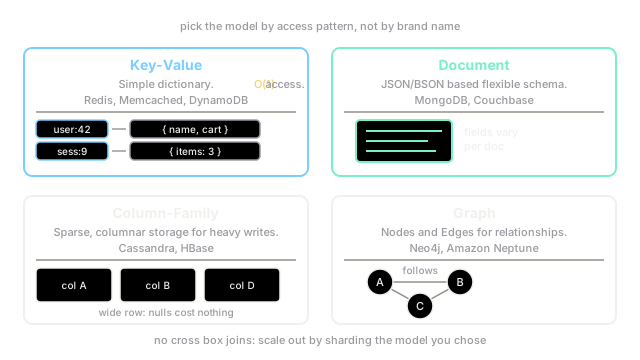
NoSQL databases fall into four broad categories - key-value, document, wide-column, and graph - each optimized for a different data shape and access pattern. Matching a category to a workload is far more useful in an interview than memorizing product names.
Key Concepts
Before reaching for these, know when to leave the relational world at all - see SQL vs NoSQL. The four canonical categories compare as follows:
| Category | Data model | Typical access | Example stores |
|---|---|---|---|
| Key-value | Opaque value addressed by a unique key | Get/put by key | Redis, DynamoDB |
| Document | Self-describing JSON-like documents | Query by key or by fields | MongoDB, Couchbase |
| Wide-column | Rows grouped into dynamic column families | Query by partition + clustering key | Cassandra, HBase |
| Graph | Nodes and edges carrying properties | Traverse relationships | Neo4j, Neptune |
- Key-value is the simplest model: the store treats the value as opaque bytes and offers blisteringly fast lookups by key, ideal for caches and sessions.
- Document stores understand the structure inside each record, so you can index and query on nested fields while still varying the shape per document.
- Wide-column stores organize data by a partition key that decides placement and clustering keys that sort rows within a partition, which suits huge, write-heavy, query-by-key workloads.
- Graph stores make relationships first-class, so multi-hop traversals (friends-of-friends, recommendations) stay cheap instead of exploding into recursive joins.
Key-value and wide-column stores commonly distribute data across nodes using Consistent Hashing, which spreads keys evenly and limits how many keys move when the cluster grows or shrinks.
Trade-offs
Simpler models scale and perform more predictably but answer fewer question shapes: a key-value store is fast yet blind to what it stores, so you cannot query by value. Richer models buy query power at a cost - graph traversals are expensive to shard, and document stores tempt you into unbounded nesting. The skill is choosing the least powerful model that still serves your access pattern.
Interview Tips
- Lead with the access pattern, then name the category, then a representative product.
- If asked "why not the others?", contrast against the access pattern rather than listing features.
- Mention that a single system often uses several categories for different subsystems.
Summary
- NoSQL splits into four categories: key-value, document, wide-column, and graph.
- Key-value is fastest but opaque; document adds field-level queries.
- Wide-column targets massive write-heavy, key-based workloads; graph targets relationship traversal.
- Many stores distribute keys with consistent hashing to scale horizontally.
- Choose the least powerful model that still satisfies the access pattern.