Storage Engine Internals
On this page
Overview
A storage engine is the component inside a database that actually writes data to and reads it from disk. The two dominant designs are B-tree-based engines, which update data in place and favor reads, and LSM-tree-based engines, which append writes and merge them in the background to favor high write throughput.
Key Concepts
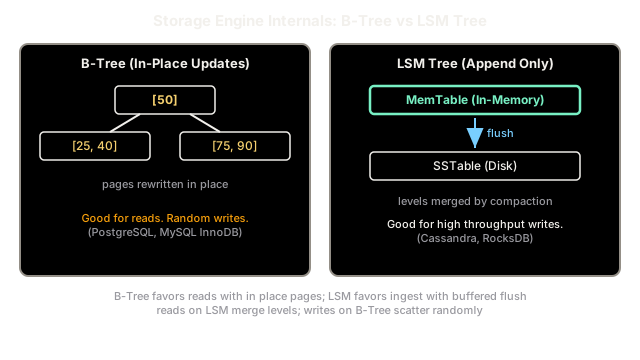
A B-tree-based engine keeps keys in a balanced, sorted tree and updates pages in place. Reads are fast and predictable because a key sits in exactly one place, but writes may require random disk I/O and page splits.
An LSM-tree-based engine (log-structured merge-tree) buffers writes in an in-memory table (a memtable), then flushes them as immutable sorted files (SSTables) on disk. A background compaction process merges these files to reclaim space and keep reads bounded.
Because a key can exist in several SSTables, a read may check multiple files; engines mitigate this with in-memory summaries and Bloom filters that quickly rule out files that cannot contain the key.
| Aspect | B-tree | LSM-tree |
|---|---|---|
| Write path | In-place update | Append to memtable, later compaction |
| Write pattern | Random I/O | Sequential I/O |
| Read performance | Fast and predictable | May scan several SSTables |
| Best for | Read-heavy, transactional | Write-heavy, high-ingest |
These engines are what make Database Indexing concrete: a B-tree index updates in place on every write, while an LSM index absorbs writes cheaply and pays later during compaction.
Trade-offs
LSM-trees accept read amplification (checking several files) and background compaction cost in exchange for very high, sequential write throughput. B-trees accept write amplification and random I/O in exchange for stable, low-latency reads. Neither wins outright - the right engine follows whether the workload is write-heavy ingest or read-heavy transactions.
Interview Tips
- When a system is write-heavy (metrics, events, chat history), reach for an LSM-backed store and say why.
- For read-heavy transactional workloads, a B-tree engine is the safer default.
- Mentioning compaction and Bloom filters signals real depth on LSM internals.
Summary
- The storage engine decides whether a database is read- or write-optimized.
- B-tree engines update in place: fast, predictable reads with random-I/O writes.
- LSM-tree engines append and compact: high sequential write throughput with read amplification.
- LSM reads use Bloom filters to skip SSTables that cannot hold a key.
- Match the engine to the workload: LSM for write-heavy ingest, B-tree for read-heavy transactions.