Distributed Locks
On this page
Overview
A distributed lock lets multiple processes on different machines agree that only one of them may act on a shared resource at a time. Unlike an in-process mutex, it must survive crashes, network delays, and the reality that the lock holder might freeze at the worst possible moment - so correct designs use expiring leases and fencing tokens, not just a flag in a shared store.
Key Concepts
A safe distributed lock needs three properties: mutual exclusion (at most one holder), deadlock freedom (a crashed holder's lock is eventually released), and fault tolerance (the lock service itself survives node loss).
Leases provide deadlock freedom: a lock is granted for a bounded time and auto-expires, so a dead holder cannot block others forever. But leases create a danger - the holder may not know its lease expired.
Fencing tokens solve that danger. Each lock grant returns a monotonically increasing number. The protected resource records the highest token it has seen and rejects any write carrying a smaller one, so a stalled old holder that wakes up is fenced off.
Locks are typically built on a strongly consistent coordination service that already solves distributed consensus and leader election:
| Backing store | Mechanism | Notes |
|---|---|---|
| ZooKeeper | Ephemeral sequential znodes | Auto-release on session loss; battle-tested |
| etcd | Leases + compare-and-swap | Used by Kubernetes for coordination |
| Redis (single) | SET key val NX PX ttl |
Fast but not safe under failover without care |
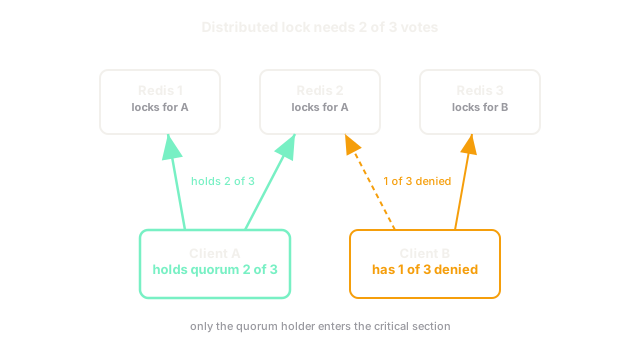
| Redis (Redlock) | Quorum across N masters | Debated; needs fencing for correctness |
Whenever a lock exists mainly to prevent duplicate side effects, prefer making the operation idempotent so a rare double-execution is harmless.
Trade-offs
A lock on a strongly consistent store (ZooKeeper, etcd) is safe but adds latency and a dependency on a CP system that may reject requests during a partition. A lock on Redis is fast and simple but trades safety: under failover a lock can be granted twice, so it needs fencing tokens or an idempotent resource to stay correct. The deeper trade-off is philosophical - distributed locks are expensive and fragile, so the strongest designs avoid needing them by partitioning work (each key owned by one worker) or by making operations idempotent.
Interview Tips
- Never propose a bare "SET NX in Redis" lock without mentioning lease expiry and fencing tokens.
- Say the safest lock is the one you avoid: partition ownership or idempotency often removes the need entirely.
- For strong safety, name ZooKeeper/etcd; for speed with caveats, name Redis and state the risk.
- Distinguish a lock (mutual exclusion) from leader election (a durable single leader) - related but not the same.
Summary
- A distributed lock enforces single-holder access to a resource across machines.
- It must provide mutual exclusion, deadlock freedom (via expiring leases), and fault tolerance.
- Leases prevent dead holders from blocking forever but let stalled holders act late.
- Fencing tokens (monotonic numbers the resource enforces) are what make locks actually safe.
- Prefer avoiding locks via partitioned ownership or idempotency; use ZooKeeper/etcd when you need real safety.