Merkle Trees (Anti-Entropy)
Overview
A Merkle Tree (or Hash Tree) is a data structure used in distributed systems to efficiently verify data integrity and detect inconsistencies between replicas. Instead of sending raw data over the network to compare databases, nodes exchange and compare tree nodes containing hashes, minimizing bandwidth usage.
Key Concepts
In distributed databases like Cassandra or DynamoDB, replicas can drift out of sync due to network partitions or dropped writes. They run a background process called Anti-Entropy to find and fix these differences.
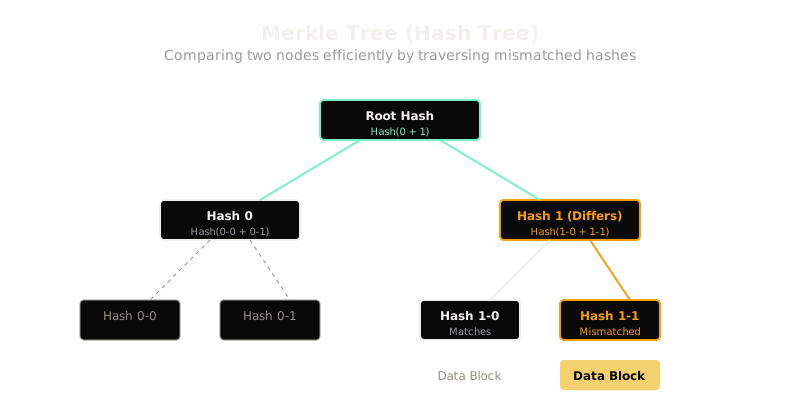
A Merkle Tree is constructed bottom-up:
- Leaf nodes contain hashes of the actual data blocks (or key ranges).
- Non-leaf nodes contain hashes of their children.
- The Root node contains a single hash representing the entire dataset.
Synchronization Flow:
- Node A and Node B exchange their root hashes.
- If the root hashes match, their datasets are identical. They stop.
- If they differ, they exchange the hashes of their children.
- They recursively traverse down the tree, only following the branches where the hashes differ.
- Once they reach the leaves, they know exactly which data blocks differ and synchronize only those blocks.
Because the tree is a summary of the data, the network overhead is proportional to the number of differences, not the size of the total dataset.
Trade-offs
Merkle Trees drastically reduce the network bandwidth required for anti-entropy and allow the system to heal silently in the background without affecting read/write latency. However, computing the tree continuously on every write is expensive. Therefore, most systems recalculate the Merkle Trees periodically or only maintain them over specific key ranges, meaning anti-entropy is an eventual consistency repair mechanism, not a real-time guarantee.
Interview Tips
- Use Merkle Trees when asked how distributed databases (Cassandra/Dynamo) repair themselves after a node comes back online from a long outage.
- Emphasize the difference between Hinted Handoff (quick, short-term repair for temporary node failures) and Anti-Entropy with Merkle Trees (comprehensive, long-term repair for silent data corruption or dropped writes).
- Mention that Merkle Trees trade CPU cycles (computing hashes) to save network bandwidth (transferring data).
Summary
- Merkle Trees are hierarchical data structures where every node is a hash of its children.
- They are used for Anti-Entropy—a background process to synchronize replicas in distributed databases.
- Nodes compare roots, then recursively compare children to find the exact data that differs.
- They minimize network bandwidth by transferring hashes instead of raw data.
- They are an eventual consistency mechanism used by Cassandra, DynamoDB, and Blockchain networks.