PACELC Theorem
On this page
Overview
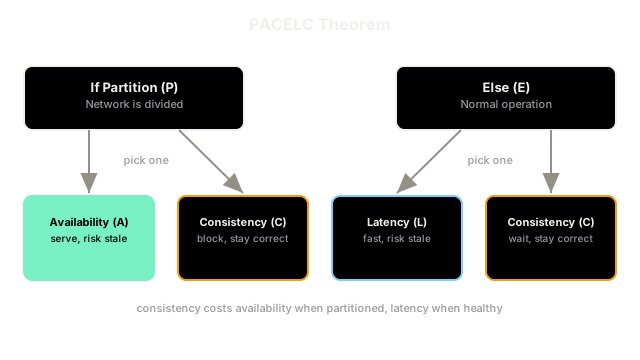
The PACELC theorem extends the CAP theorem by describing the trade-off a distributed system makes even when the network is healthy. It reads: if there is a Partition (P), choose between Availability (A) and Consistency (C); Else (E), when the system runs normally, choose between Latency (L) and Consistency (C).
Key Concepts
PACELC splits reasoning into two situations:
- During a partition (PA vs PC): identical to CAP's availability-versus-consistency choice.
- Else, no partition (EL vs EC): to guarantee that every replica agrees on a value, a write must reach and be acknowledged by multiple replicas before returning. That coordination adds latency. A system can instead return quickly after one replica accepts the write (low latency) and propagate the change asynchronously, which weakens consistency.
Systems are classified by both halves, such as PA/EL or PC/EC. The Else branch is really a statement about replication: waiting for more replicas raises both durability and consistency but costs round trips, while replying early trades that guarantee for speed.
| Classification | Partition behavior | Normal behavior | Example |
|---|---|---|---|
| PA/EL | Stay available | Favor low latency | DynamoDB, Cassandra |
| PC/EC | Stay consistent | Favor consistency | VoltDB, single-node MySQL |
| PA/EC | Stay available | Favor consistency | MongoDB (default) |
Trade-offs
The Else branch is a dial, not a switch. Requiring acknowledgment from a quorum of replicas moves you toward EC and adds the latency of the slowest replica in the quorum; acknowledging after a single replica moves you toward EL and risks serving values that have not yet propagated. The same store can sit at different points per operation, letting a critical write pay for consistency while a cheap read stays fast.
| Lean EC (consistency) when | Lean EL (latency) when |
|---|---|
| Reads must reflect the latest write | Fast response matters more than freshness |
| Correctness outweighs a few extra milliseconds | Slightly stale data is harmless |
Interview Tips
- Introduce PACELC right after CAP to cover the normal-operation case that CAP ignores.
- Say the classification aloud, for example "DynamoDB is PA/EL," to sound precise.
- Tie the Else branch to a concrete number: quorum writes add a network round trip, often single-digit milliseconds within a region and far more across regions.
- Note that the same database can be tuned per request, so the label describes defaults, not a hard limit.
Summary
- PACELC extends CAP by adding the Else branch that applies when no partition is present.
- During a partition, PACELC repeats CAP's availability-versus-consistency choice.
- In normal operation, the choice is latency versus consistency, driven by how many replicas a write waits for.
- Systems are labeled on both axes, such as PA/EL or PC/EC.
- PACELC captures the everyday trade-off that governs most of a system's runtime, not just failure scenarios.