Visual explainer
Embedding Space
How models convert fuzzy semantic meaning into precise mathematical distances.
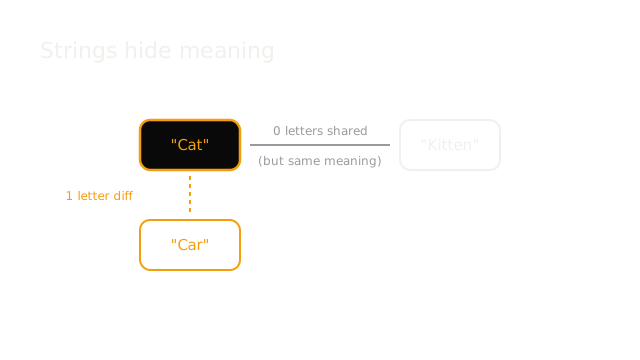
To a computer without an embedding model, text is just a sequence of arbitrary characters. "Cat" and "Car" look nearly identical because they share two out of three letters, while "Cat" and "Kitten" appear completely unrelated. Raw strings have no built-in concept of semantic meaning, making them useless for reasoning.
Words Become Vectors
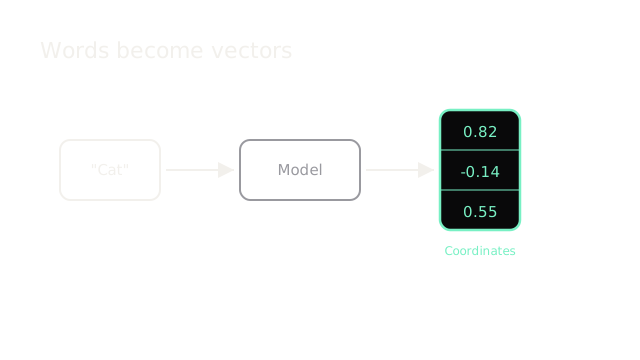
An embedding model solves this limitation by reading a word and outputting a fixed-length array of numbers—a vector. This array acts as a precise set of coordinates, giving the concept a specific physical location in a mathematical space. The word is no longer a string; it is a point.
Meaning Becomes Distance
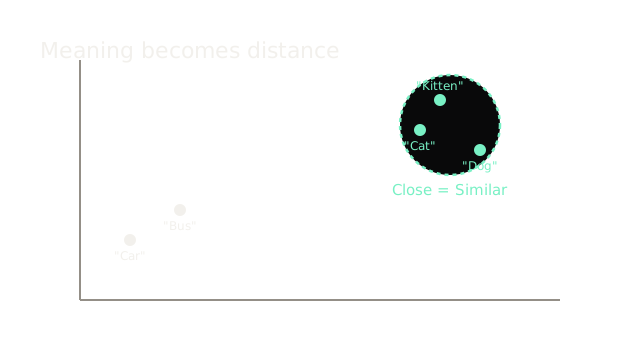
When thousands of words are mapped into this space, semantic similarity translates directly into physical proximity. Pets cluster tightly together in one region, while vehicles form their own group in another. The incredibly fuzzy human concept of "meaning" is transformed into a simple operation: measuring the physical distance between two coordinate points.
Relationships Become Geometry
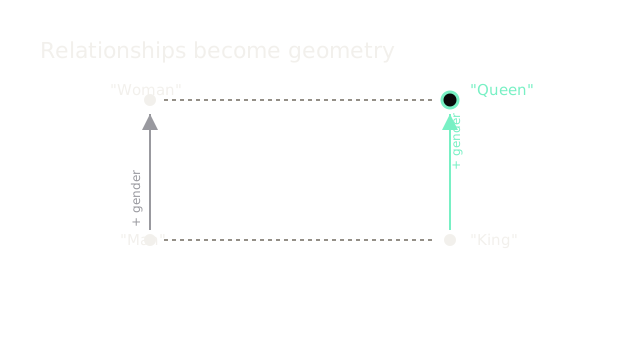
Because the space is structured geometrically, relationships between words become consistent, reusable vectors. The distance and direction from "Man" to "Woman" is mathematically identical to the path from "King" to "Queen". This allows the model to perform semantic arithmetic, capturing nuance that dictionaries cannot.
Where It Breaks
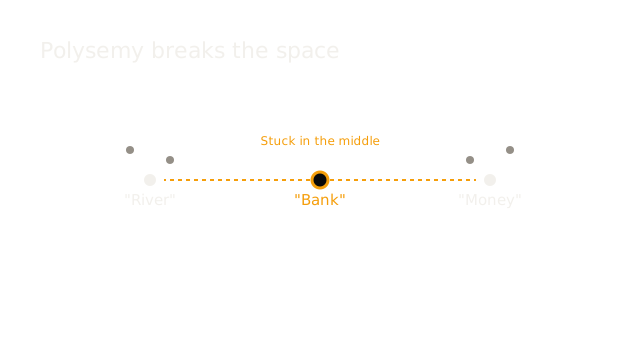
Classical static embeddings assign exactly one vector per word in the vocabulary. Polysemous words like "Bank" (which could mean a river edge or a financial institution) are forced into a single compromise position in the middle. By trying to sit between both clusters, the word fails to accurately represent either meaning.
The Quick Version
- Strings hide meaning: Computers cannot understand raw characters natively.
- Words to coordinates: Embedding models translate words into arrays of numbers.
- Meaning is distance: Semantically similar words sit physically closer together.
- Geometry captures logic: Consistent spacing allows for semantic vector arithmetic.
- The static limit: A single point cannot hold multiple definitions at once.