Visual explainer
Self-Supervised Learning
Extract dense supervision directly from raw, unlabelled data using pretext tasks like masking and contrastive pairs to pretrain foundation backbones for downstream fine-tuning.
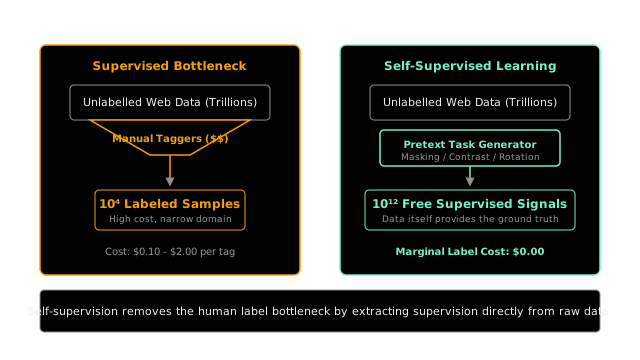
Supervised deep learning achieves remarkable accuracy when supplied with massive quantities of ground-truth labels. However, manual human annotation forms a severe operational bottleneck. Taggers charge between 0.10 and 2.00 USD per sample, and human review throughput is bounded by manual reading and verification speeds. Consequently, supervised datasets typically contain to carefully curated examples.
Meanwhile, the open web contains trillions of tokens of raw prose, billions of open photos, and petabytes of unstructured audio. Attempting to label this entire repository manually would exhaust any organization's financial budget.
Self-Supervised Learning (SSL) breaks this bottleneck by changing the source of supervision: instead of paying humans to generate external target labels , an algorithmic pretext task automatically extracts the supervisory signal from the raw data itself at zero marginal cost.
Hide Then Rebuild Words
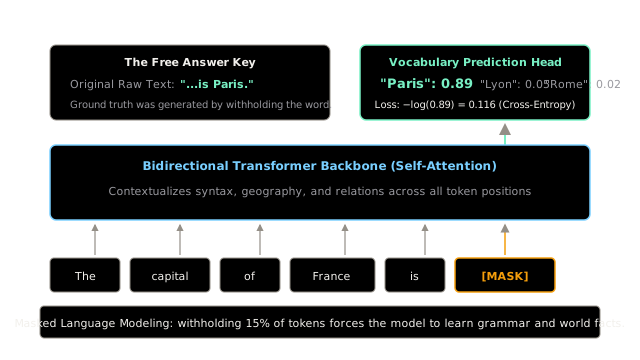
In natural language processing, Masked Language Modeling (MLM)—popularized by architectures like BERT—serves as the canonical self-supervised pretext task.
During pre-training, the model ingests raw, unlabelled text sequences and randomly masks a fixed proportion of tokens (conventionally ):
- of chosen tokens are replaced with a special
[MASK]token. - are replaced with a random vocabulary token.
- remain unchanged to prevent the representation from overfitting strictly to the mask symbol.
For an input sentence like "The capital of France is [MASK]", the bidirectional Transformer backbone propagates activations through self-attention layers, allowing each position to attend to both left and right context. A classification head on the masked position computes a softmax distribution over the entire vocabulary:
Because the original uncorrupted sentence already contained the true word "Paris", the ground truth answer key is completely free. To correctly predict missing words across billions of sentences, the Transformer is forced to internalize syntax, grammar, geographic facts, and common-sense reasoning.
Pull Pairs Push Strangers
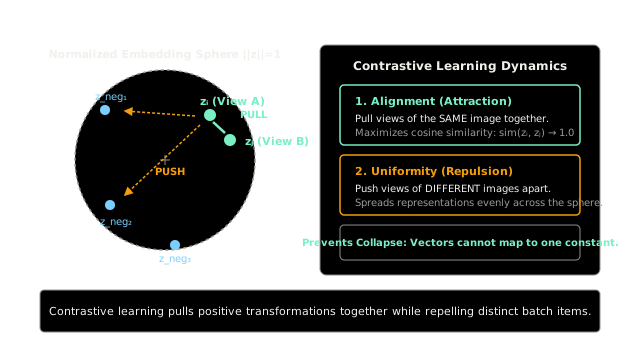
While masking works naturally on discrete, tokenized language, continuous image pixels do not map cleanly to fixed vocabularies. For computer vision, self-supervised learning relies heavily on contrastive representation learning (such as SimCLR and MoCo).
Contrastive methods operate on a normalized embedding hypersphere () driven by two complementary geometric forces:
- Alignment (Attraction): Two augmented views derived from the same underlying image are projected into representations . An attractive objective pulls these positive vectors together, maximizing their cosine similarity:
- Uniformity (Repulsion): If the model only minimized positive distance, it would suffer catastrophic representation collapse—mapping every input image to a single identical constant vector (). To prevent collapse, repulsive forces simultaneously push representations of distinct images in the mini-batch apart, distributing features uniformly across the hypersphere.
Same Dog Still Matches
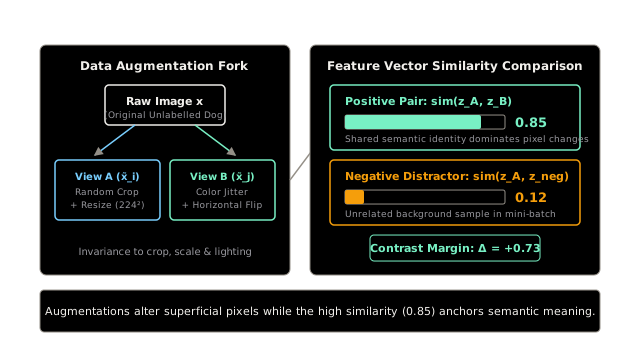
To teach an encoder semantic object identity rather than superficial pixel memorization, contrastive frameworks apply aggressive stochastic data augmentations:
- View A (): A random bounding box crop resized to pixels, capturing close-up facial features.
- View B (): Color jitter (altering brightness, contrast, and saturation), Gaussian blur, and a horizontal flip, capturing overall body silhouette in altered lighting.
Despite severe pixel-level divergence between the two views, both images represent the same physical entity. The visual backbone (e.g. ResNet or Vision Transformer) outputs embeddings that yield high cosine similarity ().
Meanwhile, an unrelated image from the mini-batch (such as a car or a cat) yields low similarity (). The resulting contrast margin () drives the InfoNCE loss:
The temperature hyperparameter (typically to ) sharpens the penalty against hard negative distractors, compelling the network to discard superficial lighting artifacts and focus strictly on invariant semantic structure.
Small Labels Win Big
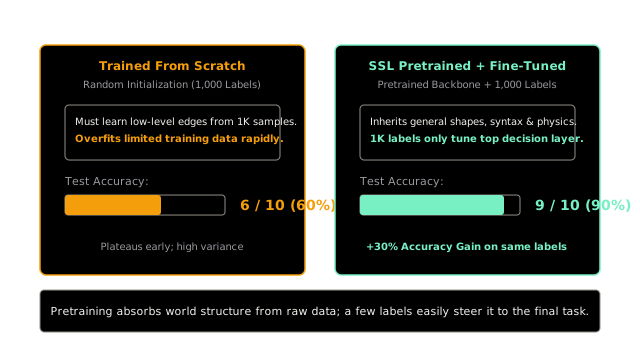
The ultimate dividend of self-supervised learning appears during downstream transfer. Consider a specialized clinical classification task with only labeled training images:
- Model A (Trained from Scratch): Initialized with random weights , the network must learn basic edge detectors, texture filters, and anatomical shapes entirely from the samples. The model overfits quickly, and held-out test accuracy plateaus at ( out of correct).
- Model B (Self-Supervised Pretrained Backbone): The backbone has already processed millions of unlabelled images, internalizing robust visual representations. When fine-tuned on the same labeled instances, the network only needs to adjust its top linear classification layer. It converges in a few epochs and achieves test accuracy ( out of correct).
Pretraining on raw data provides a massive sample efficiency boost: the model requires fewer human labels to achieve production-grade performance.
Match Task To Data
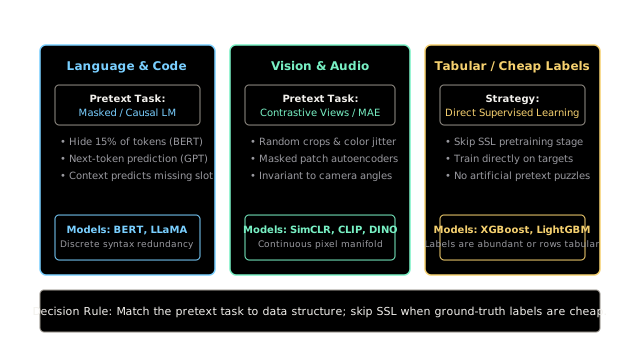
Selecting an effective self-supervised strategy requires aligning the pretext task with the intrinsic inductive bias of the data modality:
1. Language and Code: Masked and Autoregressive Prediction
Text is inherently discrete, sequential, and highly structured. Masked language modeling (BERT) and next-token prediction (GPT, LLaMA) leverage the natural syntactic dependencies between neighboring words.
2. Vision and Audio: Contrastive and Masked Patch Autoencoding
Continuous pixel arrays contain high spatial redundancy. Contrastive learning (SimCLR, CLIP) and masked image modeling (MAE, DINO) enforce invariance across spatial crops, color transforms, and patch reconstructions.
3. Tabular and High-Label Regimes: Skip SSL
In structured tabular datasets (e.g. financial credit tables) or domains where ground-truth labels are cheap and plentiful (), self-supervision adds unnecessary architectural complexity. Standard supervised gradient boosted decision trees (XGBoost, LightGBM) or end-to-end classifiers remain the preferred engineering baseline.
Where It Breaks
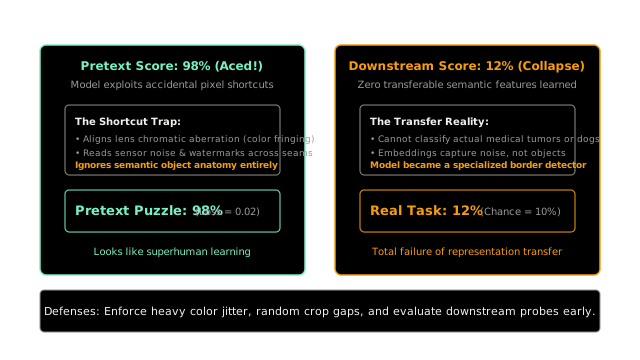
The primary vulnerability of self-supervised learning is pretext shortcut learning: neural networks naturally optimize the path of least resistance to minimize loss, often exploiting unintended low-level statistical artifacts rather than high-level semantic meaning.
The Chromatic Aberration Cheat
In early self-supervised spatial jigsaw puzzles (where images were cut into patches and the model predicted their relative spatial positions), networks quickly achieved accuracy. Researchers discovered the models were not recognizing objects; instead, they were aligning subtle lens chromatic aberration—color fringing along optical edges where green and purple wavelengths refract unevenly. The network became an expert lens aberration detector ( pretext score) while downstream semantic classification collapsed to near-random chance ().
Engineering Safeguards Against Shortcuts
- Aggressive Color Jitter & Desaturation: Randomly dropping color channels removes chromatic aberration shortcuts.
- Patch Gap Jitter: In jigsaw or masked patch models, leaving unpredictable spatial gaps between patches prevents models from matching edge continuity.
- Early Downstream Probing: Continuously evaluate frozen representations with a linear probe on validation tasks throughout pretraining to ensure representations generalize beyond the artificial pretext puzzle.
The Quick Version
- Human labeling is financially and logistically prohibitive at scale; SSL extracts free labels from raw data.
- Masked language modeling hides of tokens, using surrounding bidirectional context to predict missing words.
- Contrastive learning pulls positive transformed views together while repelling distinct batch items to prevent collapse.
- Invariance to aggressive crops and color shifts preserves high cosine similarity () across semantic pairs.
- SSL pretraining provides a sample efficiency dividend, allowing small labeled datasets to achieve high accuracy ().
- Match the pretext task to data topology: masking for text, contrastive crops for vision, direct supervision for tabular data.
- Models exploit low-level pretext shortcuts (like lens chromatic fringing); enforce heavy color jitter and validate with linear probes.