Visual explainer
Support Vector Machines
Draw the widest street between two classes, anchor the boundary on border support vectors, and forgive slack crossings when data overlaps.
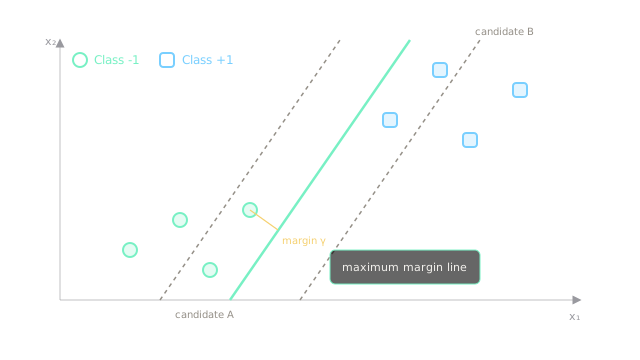
Given linearly separable binary data with labels , an infinite number of hyperplanes achieve zero training error. However, lines that pass dangerously close to sample points possess negligible margin clearance. A boundary that skims within 0.15 of a circle or 0.20 of a square is fragile: any minor measurement noise in unseen test data will cross the threshold and trigger a misclassification. Achieving zero training error is not enough; true generalization requires maximizing geometric clearance from both classes.
Width Rests on Three
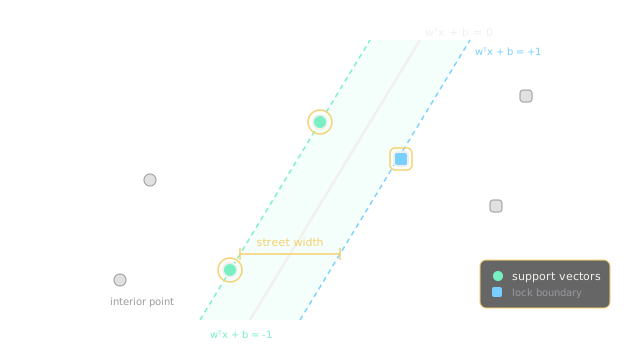
Support Vector Machines solve this ambiguity by finding the unique maximum margin hyperplane. The separating corridor—the "street"—is bounded by two parallel canonical gutter lines: and . The orientation and width of this street are anchored exclusively by the active constraint points that lie directly on the gutters: the support vectors. In a two-dimensional feature space, typically three points (two from one class, one from the other) lock the hyperplane. By Karush-Kuhn-Tucker (KKT) complementary slackness, all interior non-support vectors carry dual Lagrange multipliers ; moving or deleting them changes nothing about the final decision boundary.
Short Weights, Wide Street
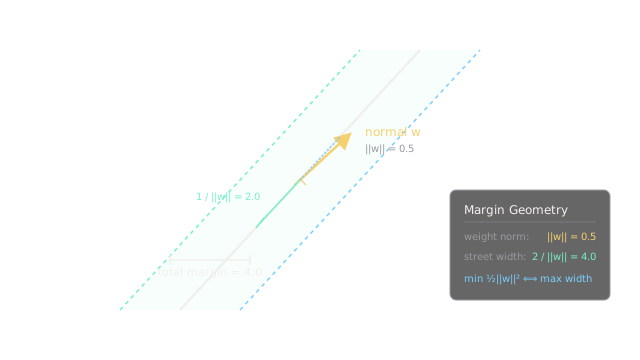
The normal weight vector is orthogonal to the decision hyperplane. Projecting the distance between the two gutter hyperplanes onto the unit normal yields an exact geometric margin width of . If the weight norm is , the half-margin clearance on each side is , creating a total street width of . Because corridor width is inversely proportional to weight length, maximizing the margin is mathematically identical to minimizing , turning classification into a convex quadratic programming problem with a guaranteed global optimum.
Lift, Then Slice
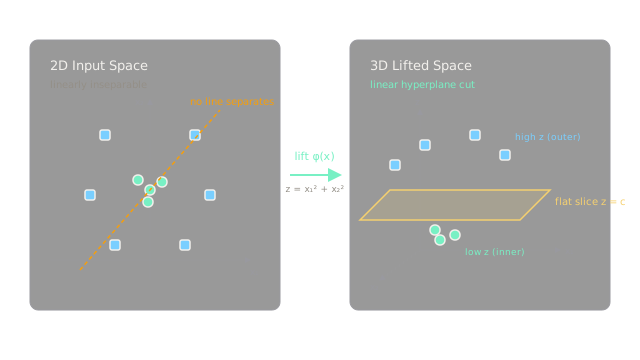
When data is non-linearly separable—such as an inner circle surrounded by an outer ring—no straight line in the original two-dimensional input space can divide them. The kernel trick circumvents this limitation by mapping points into a higher-dimensional feature space via a mapping function . In this three-dimensional space, the quadratic term lifts the outer ring high onto a paraboloid while the inner circle remains near the base. A simple flat horizontal plane cleanly slices them apart. Mercer's theorem allows computing dot products in this high-dimensional space directly through kernel functions without explicitly constructing the coordinates.
Forgive Twice, Widen
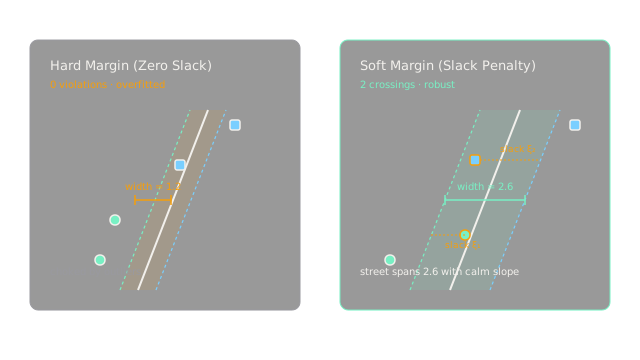
Real-world datasets contain label noise and overlapping feature distributions. A strict hard-margin SVM insists on zero misclassifications (), forcing the separating street to contract to a narrow width of just to squeeze past two rogue outliers. Soft-margin SVMs introduce non-negative slack variables , relaxing the constraint to . By accepting two minor margin violations (, ), the street widens from to —a increase in margin width. Tolerating bounded training slack creates a far more stable boundary that generalizes better to unseen test data.
How Strict, C?
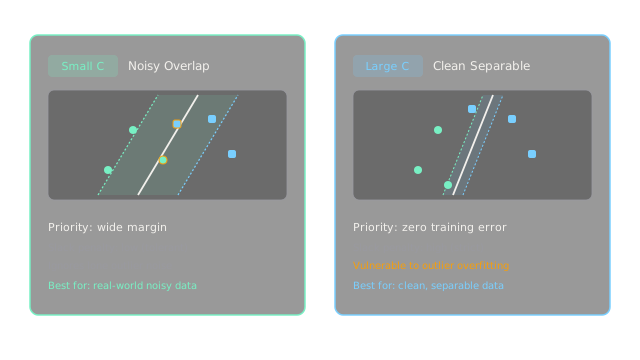
The soft-margin objective function balances street width against violation penalties: . The hyperparameter controls this tradeoff:
- Small : Low penalty on slack. The optimizer prioritizes a wide, smooth separating street and forgives noisy intrusions. Ideal for noisy, overlapping datasets where chasing zero training error causes overfitting.
- Large : Heavy penalty on slack. The optimizer strictly enforces margin compliance, narrowing the corridor to eliminate training errors. Ideal for clean, separable datasets where outliers are absent.
Where It Breaks
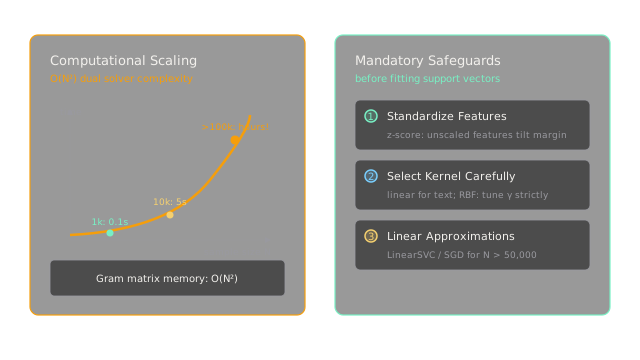
Despite their theoretical elegance, support vector machines exhibit sharp operational bottlenecks:
- Quadratic scaling wall: Standard quadratic programming solvers for the dual formulation scale as to in sample size . Training is instantaneous for 1,000 samples, but stalls for hours past 100,000 rows as storing and computing the kernel Gram matrix exhausts memory.
- Feature scale sensitivity: SVM relies on Euclidean distances. If one feature has variance 1,000 while another has variance 1, the unscaled feature dominates the margin normal vector. Standardizing features to zero mean and unit variance (-score) is mandatory before training.
- Kernel parameter sensitivity: Non-linear Radial Basis Function (RBF) kernels require precise tuning of the bandwidth parameter . Setting too high causes the model to form isolated decision islands around individual training points, destroying generalization. For large-scale linear classification, linear approximations such as
LinearSVCor stochastic gradient descent estimators should replace exact dual solvers.
The Quick Version
- Infinite lines split separable training data; only the maximum margin line maximizes generalization clearance.
- Three boundary support vectors lock the street gutters; interior points have zero mathematical influence on the weights.
- Total margin width equals ; minimizing weight length directly widens the corridor.
- Non-linear data maps into higher dimensions via kernels, where a flat hyperplane cuts them apart.
- Soft margins introduce slack variables , allowing bounded crossings to widen the street from 1.2 to 2.6.
- Small tolerates noise for a wider street; large forces strict separation on clean data.
- SVM dual solvers scale as and require feature standardization and careful kernel tuning.