Visual explainer
Time Series Forecasting (ARIMA)
Time series forecasting predicts future values by breaking past data into trend, seasonality, and residual noise.
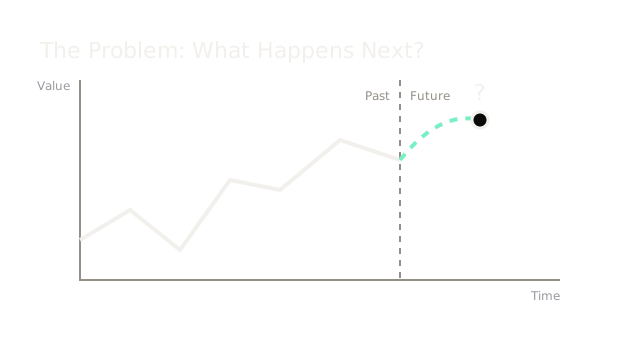
Unlike standard data where each row is independent, time series data is a journey. To guess what happens next, we look at the sequence of steps taken so far.
Splitting the Signal
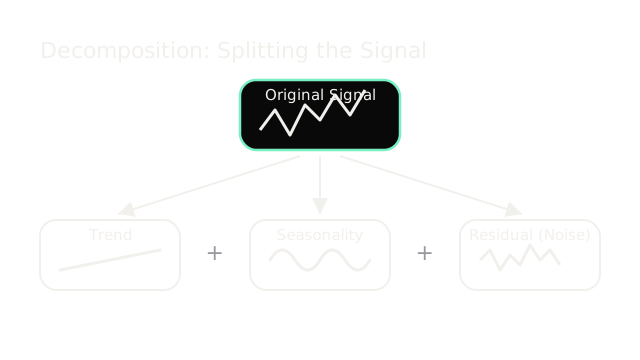
A raw time series is messy, but we can decompose it into three simpler parts: a general direction (trend), repeating cycles (seasonality), and random fluctuations (residual noise).
Predicting from the Past
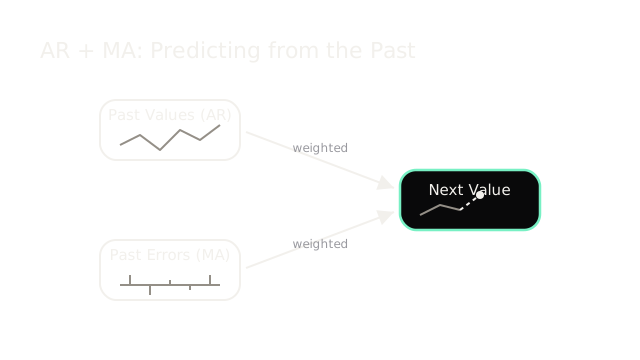
Once trend and seasonality are handled, ARIMA focuses on the noise. It uses recent past values (Auto-Regressive) and recent past prediction errors (Moving Average) to estimate the next step.
The Forecast
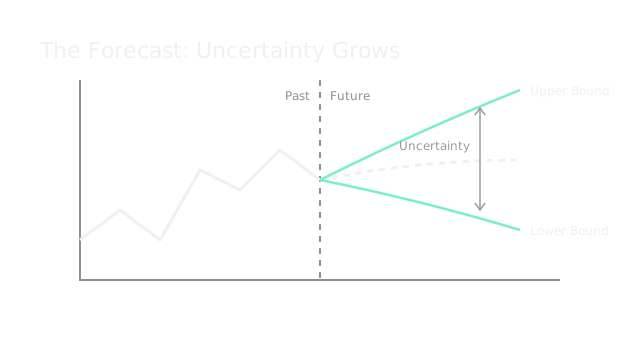
Because every prediction carries a small error, forecasting further ahead means accumulating those errors. The model gives a best guess surrounded by a confidence band that widens over time.
Where It Breaks
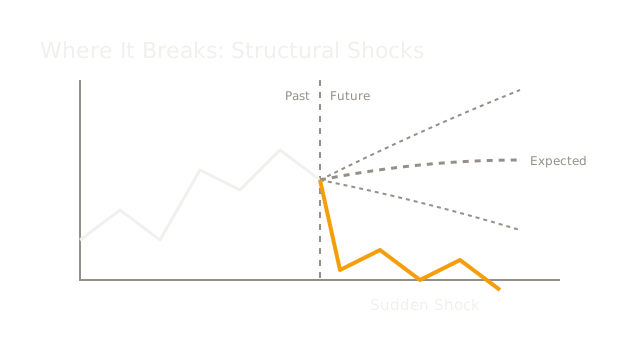
Time series models assume the future will behave like the past. A sudden, unprecedented external shock—like a pandemic or a policy change—breaks this assumption, rendering the forecast useless.
The Quick Version
- Sequence matters: Data points depend on the points that came before them.
- Decomposition: Signals are split into trend, seasonality, and noise.
- ARIMA: Models the remaining noise using past values (AR) and past errors (MA).
- Uncertainty: Confidence bands grow wider the further ahead we look.
- Fragility: Sudden structural breaks ruin the prediction completely.
What to Read Next
- Transfer LearningWhy training massive networks from scratch on small datasets fails, and how feature extraction and fine-tuning let you reuse pre-learned structure instead.
- TransformersA visual walkthrough of the Transformer architecture, from self-attention and positional encodings to the full encoder-decoder stack.