Agentic AI is Not Just the Next RPA
The conversation around Agentic AI often frames it as a slightly more capable version of Robotic Process Automation (RPA). It’s an appealing analogy for executives trying to slot a new paradigm into an old budget category, but it’s fundamentally wrong.
The Core Misunderstanding
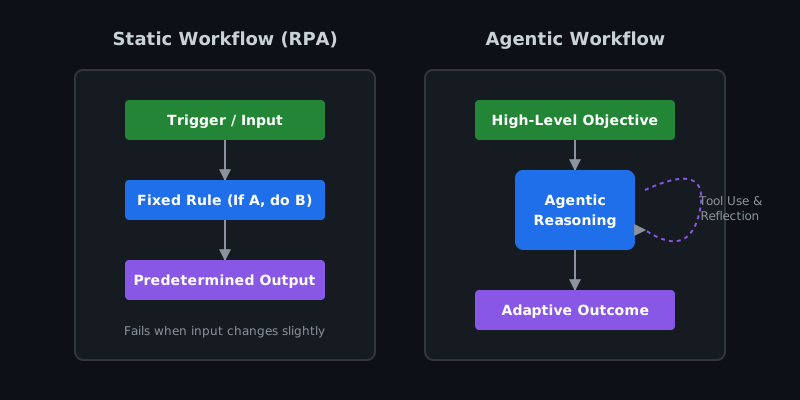
Traditional automation (RPA) requires rigid, deterministic rules. If X happens, click Y, then paste Z. When a website redesigns a button or an invoice changes formats, the script breaks. The logic is static, hardcoded by a human, and utterly incapable of adapting.
Agentic systems represent a shift from static logic to goal-directed reasoning. Instead of giving a system a step-by-step recipe, you give it an objective, access to tools, and an LLM capable of planning. The agent figures out the steps on its own.
The Architectural Shift
When a business process encounters an edge case, a static script throws an error for human review. An autonomous agent powered by Multi-Agent Orchestration or sophisticated Tool Use handles edge cases dynamically. It can evaluate failure states, adjust its strategy, and execute alternative paths without human intervention.
This isn't merely an operational upgrade; it's a structural change to how we design business logic. We are moving from hardcoded "if/then" statements to probabilistic reasoning loops.
The Reality Check
Of course, the autonomy is only as good as the system's evaluation bounds. Unconstrained agents hallucinating inputs into an ERP system can do catastrophic damage faster than any human. Proper sandboxing, robust fallback protocols, and rigorous observability aren't optional add-ons—they are the foundation that makes agentic workflows viable in production.
(Correct as of September 2026).
The Quick Version
Stop thinking of agents as better macros. Agentic AI replaces human-authored static rules with dynamic, model-driven reasoning loops. This means workflows that break gracefully, adapt to messy inputs, and handle edge cases that would instantly derail traditional automation.