Claude 3.5 Sonnet is the New Baseline for AI Coding
The debate over the "best" AI coding assistant used to be a coin toss between OpenAI and whichever open-source model was trending that week. But as of late 2026, the landscape has fractured into highly specialized domains, and a clear hierarchy has emerged. If you are writing software, Claude 3.5 Sonnet isn't just an option—it is the new baseline.
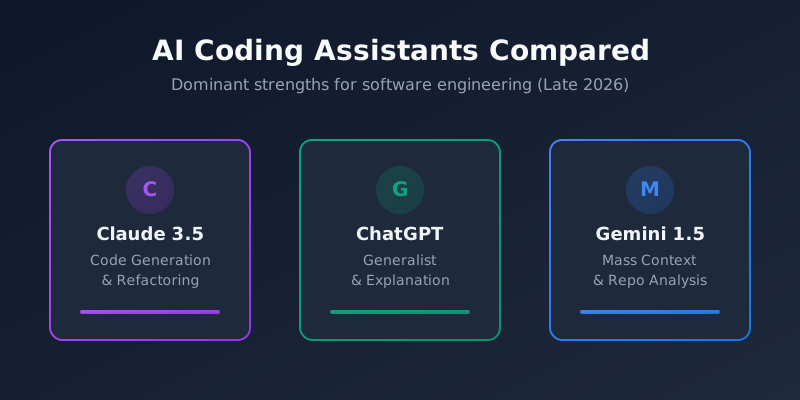
ChatGPT remains the ultimate generalist, and Gemini is pushing the boundaries of raw context length, but when it comes to reasoning through complex codebases and orchestrating multi-file refactors, Anthropic has fundamentally changed the game.
Here is why the current generation of models demands a shift in how we choose our tools.
The Claude 3.5 Sonnet Advantage: Contextual Nuance
Writing code is rarely about generating a single function in a vacuum. It is about understanding the architectural constraints of an existing system.
Claude 3.5 Sonnet excels at what we might call contextual nuance. When you feed it a messy, undocumented TypeScript module, it doesn't just confidently guess the missing types—it flags the implicit dependencies. Its ability to maintain coherence across a deep architectural discussion is unparalleled. The introduction of "Artifacts" and system-level prompt caching only solidified its lead, allowing developers to iterate on complete components rather than stitching together disconnected code blocks.
If you are building Retrieval-Augmented Generation pipelines or fine-tuning infrastructure, Claude is currently the only model that consistently feels like a pair programmer rather than an eager, slightly reckless intern.
ChatGPT: The Generalist's Trap
OpenAI's GPT-4o remains an engineering marvel, but its behavior in coding scenarios has become increasingly frustrating for power users.
ChatGPT tends to exhibit "helpful amnesia." It will gladly write a brilliant Python script, but when asked to modify it three turns later, it frequently rewrites the entire file, subtly breaking variables it established earlier. It defaults to extreme verbosity, prioritizing explanation over execution.
While OpenAI's Advanced Data Analysis is fantastic for standalone data science tasks, ChatGPT as a dedicated IDE companion has lost ground. It is the tool you use when you need to write an email explaining your Large Language Models integration, not the tool you use to write the integration itself.
Gemini 1.5 Pro: The Context Devourer
Google's Gemini 1.5 Pro offers something neither of the others can: a 2-million token context window.
When you need to dump an entire legacy repository, three API manuals, and a database schema into a prompt to ask, "Where is the memory leak?", Gemini is your only option. It acts as an incredible search and retrieval engine.
However, its actual generation quality remains wildly inconsistent. It can summarize 50,000 lines of code brilliantly but often stumbles on standard syntax when asked to implement the fix it just proposed. Gemini is an architectural research tool, not a daily driver for syntax.
The Verdict
We are no longer in an era where one model rules every tab in your browser. The modern developer's stack is fragmented by necessity:
- Claude 3.5 Sonnet for daily software engineering, code generation, and complex refactoring.
- Gemini 1.5 Pro for repo-wide debugging and mass context analysis.
- ChatGPT for general-purpose brainstorming and non-code tasks.
If you are still trying to force all your coding workflows through a single chat interface, you are leaving productivity on the table.
(Correct as of September 2026).