How LLMs Work
Text becomes tokens, tokens become vectors, a stack of transformer blocks refines those vectors, and the last position's output becomes a probability distribution over the next token.
Why Does This Exist?
Ask someone how a large language model works and the honest answer sounds almost too simple to be the whole story: it predicts the next word, over and over, one token at a time. That's not a simplification for beginners — it's literally the entire mechanism. Everything else, the apparent reasoning, the code generation, the ability to hold a conversation, is what happens when that one mechanism runs at enough scale, on enough text, for long enough.
That simplicity is exactly why it's worth walking through carefully. If the whole system really is just "predict the next token, then do it again," a lot of behavior that looks mysterious from the outside — why it sometimes makes things up, why longer prompts cost more, why it can't un-see what it just generated — turns out to follow directly from that one fact, once the pipeline is laid out end to end.
Think of It Like This
An extremely well-read autocomplete, one word at a time
Picture the autocomplete suggestion on a phone keyboard, but imagine it had read essentially every book, article, and website available at the time it was built, and had an enormous amount of capacity to notice patterns in all of it. Each time it suggests a next word, it isn't retrieving a memorized sentence — it's computing, fresh, "given everything written so far, what word is statistically most fitting right here," using everything it absorbed during that reading.
Type a full sentence with this supercharged autocomplete, accept its suggestion, and it now has one more word of context to work with for the next suggestion. Do that thousands of times in a row, fast enough that a person can't tell the individual predictions apart, and the result reads like a considered, coherent response. It's the same mechanism as your keyboard's suggestion bar — just enormously more capable, and running in a tight loop.
How It Actually Works
The pipeline, start to finish
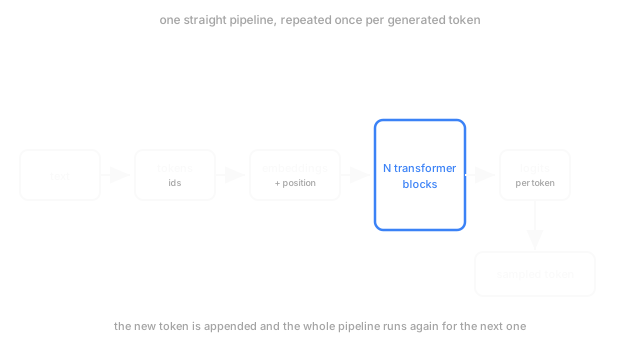
The diagram above is the entire architecture, read left to right. Tokenization splits the input text into discrete units the model can index — usually word fragments, not whole words. Embeddings turn each token id into a vector, with a positional signal added so the model knows which token came first. A stack of transformer blocks — the architecture covered in the previous band, self-attention and a feed-forward network, repeated many times — refines those vectors, letting every position gather context from every other position it's allowed to see. The final layer's output at the last position becomes logits: one raw score per possible next token, out of a vocabulary that typically runs from tens of thousands to over a hundred thousand entries. Those logits pass through a softmax to become a probability distribution, and a sampled token gets drawn from it.
Why "generate" means "loop"
Here's the detail that makes an LLM autoregressive rather than a one-shot classifier: the newly sampled token gets appended to the input, and the entire pipeline runs again — tokenize (already done, since it's appended as a token id), embed, run through every transformer block, produce new logits, sample again. Producing a 500-token response means running this full pipeline roughly 500 times, once per output token, each time conditioning on everything generated so far including its own prior outputs.
This is why generation is inherently sequential at inference time, even though the transformer's attention mechanism computes in parallel within a single forward pass: token 500 cannot be sampled before token 499 exists, because token 499 is literally part of the input to the step that produces token 500.
What the training objective actually optimizes
During training, this entire process — tokenize, embed, transform, produce logits — runs on real text, and the model is scored on how much probability it assigned to the actual next token at every position simultaneously (a detail next-token prediction covers directly). No position is treated specially; a document with 10,000 tokens supplies roughly 10,000 separate next-token predictions to learn from in one pass. That density of training signal, applied to internet-scale text, is what turns "predict the next fragment" into a system that appears to know grammar, facts, and reasoning patterns — because getting the next fragment right, over and over, quietly requires all of that.
Code
A minimal, non-batched version of the generation loop, calling out where each named step from the diagram happens.
import numpy as np
def softmax(z: np.ndarray) -> np.ndarray: e = np.exp(z - z.max()) return e / e.sum()
def generate(token_ids: list[int], model_forward, steps: int, vocab_size: int) -> list[int]: for _ in range(steps): logits = model_forward(token_ids) # tokens -> embeddings -> blocks -> logits probs = softmax(logits[-1]) # only the LAST position's logits matter next_id = int(np.random.default_rng(0).choice(vocab_size, p=probs)) token_ids.append(next_id) # append, then run the whole pipeline again return token_ids
def stub_forward(ids: list[int]) -> np.ndarray: rng = np.random.default_rng(sum(ids)) return rng.normal(size=(len(ids), 50)) # stand-in for the real transformer stack
output = generate([7, 12, 3], stub_forward, steps=3, vocab_size=50)print(output) # -> [7, 12, 3, <new>, <new>, <new>] — three tokens appended, one per loop iterationEvery call to model_forward reprocesses the entire growing sequence — that inefficiency, run naively, is exactly what makes a KV cache worth having in a real system.
Watch Out For
Assuming the model 'decides' to generate a whole response at once
There is no step where the model plans out a full sentence and then writes it down. Every single token is sampled from a distribution computed given only what came before it — the model has no privileged access to what it's about to say next, because that token doesn't exist yet in any form until it's sampled. Apparent planning ability is a learned pattern in how it distributes probability, not a separate planning stage in the pipeline.
Treating the mechanism as too simple to explain real capability
"It just predicts the next token" sounds like it should describe something much less capable than what large models actually do, and that mismatch tempts people into assuming there must be something else going on underneath. There usually isn't — the mechanism really is this simple, and the sophistication comes entirely from what gets learned when this simple objective is optimized against a very large, very diverse body of text, at a very large scale. Simple mechanism, complex learned behavior; the two aren't in tension.
The Quick Version
- The pipeline is: tokenize, embed with position, run through stacked transformer blocks, produce logits, sample a token.
- Generation is a loop — the sampled token is appended and the entire pipeline runs again for the next one.
- Training scores every position in a document simultaneously against its true next token, which is what makes the signal so dense.
- Generation is inherently sequential at inference time, even though each individual forward pass is internally parallel.
- Apparent reasoning and knowledge are downstream of this one repeated mechanism, not a separate system layered on top.