Fairness Is Not A Metric: The Structural Reality of AI Bias
Why Does This Exist?
Every few months, an organization discovers its shiny new model exhibits discriminatory behavior. The immediate reaction is almost always technical: engineers scramble to reweight the dataset, adjust the decision thresholds, or drop "problematic" features in a desperate attempt to patch the math. They run the numbers, see the disparate impact ratio tick up to 0.8, and declare the model "debiased."
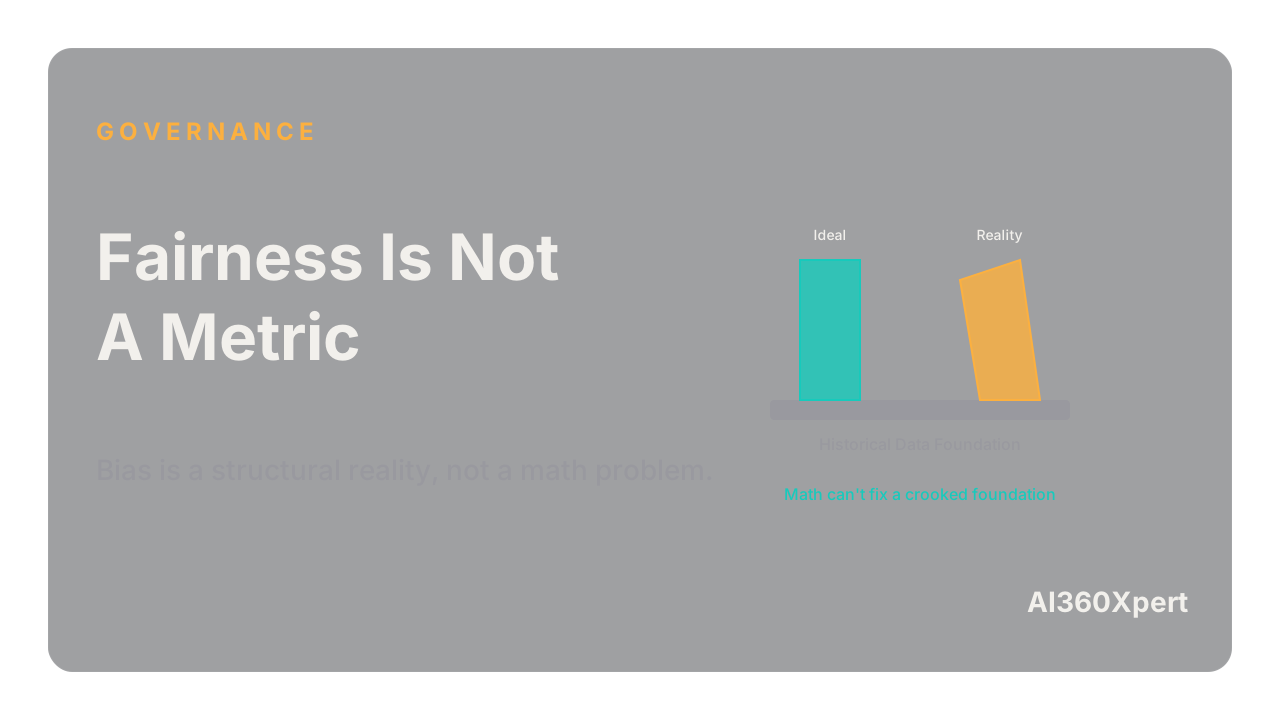
But AI fairness is not a post-hoc math problem. Algorithmic bias is rarely a technical glitch—it is a structural reflection of our training data and the world that generated it. When we treat bias as a bug to be squashed rather than a systemic issue requiring AI governance, we guarantee that the same harms will resurface in the next iteration.
Think of It Like This
Imagine a city planner building a new public transit system using solely historical ridership data from a racially segregated era. If a station isn't placed in a marginalized neighborhood, it's not because the spreadsheet had a calculation error; it's because the data itself encodes historical inequities. Tweaking the optimization algorithm doesn't solve the fact that the underlying assumptions are flawed. You need a completely different approach to community planning. We routinely fail to apply this logic to billion-parameter models.
The Myth of "Fairness Through Unawareness"
The most common—and most dangerous—myth in responsible AI is that you can achieve neutrality simply by dropping protected attributes from your dataset.
If you remove "race" or "gender" from a credit scoring model, it doesn't suddenly become blind to those attributes. It learns them anyway through proxy variables: zip codes, browsing history, and purchasing habits all carry the same latent signal. The model will confidently reproduce historical discrimination while allowing its creators to hide behind the defense that "the algorithm didn't even know."
True fairness requires acknowledging these realities explicitly during model formulation, not closing our eyes and hoping the math works out.
How We Actually Fix This
Moving beyond metrics means instituting real, structural model auditing long before a model is trained. It means asking uncomfortable questions at the design phase:
- What historical biases exist in the data we are collecting?
- Who benefits from this objective function, and who is penalized by it?
- If this system works perfectly as designed, what are the downstream social impacts?
Responsible AI development isn't just about ensuring parity across confusion matrices. It's about establishing governance frameworks that can say "no" to a project if the data fundamentally cannot support a fair outcome.
(Correct as of September 2026).
The Quick Version
Algorithmic bias is a structural problem, not a technical one. Attempting to solve it merely by tweaking decision thresholds or dropping protected attributes ignores the root cause: historical inequities encoded in data. Real responsible AI requires proactive, structural governance and auditing from the very beginning of the development lifecycle.