Beyond Checkboxes: Why Real AI Governance is Your Business's Only Moat
The Compliance Illusion
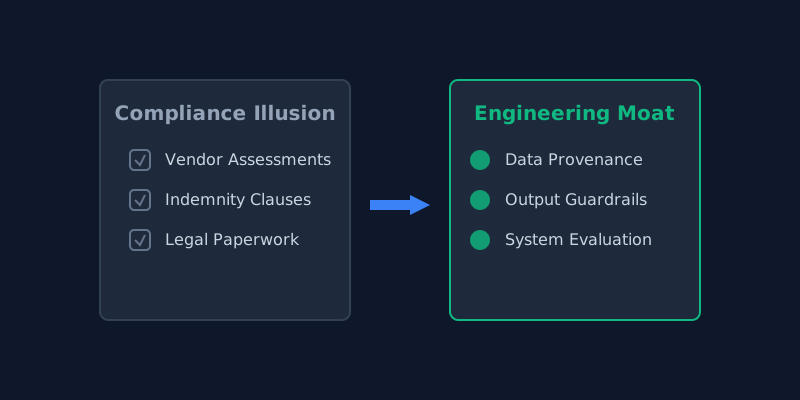
Most businesses are reacting to the incoming wave of AI regulation—like the EU AI Act or the upcoming US state-level mandates—exactly the wrong way. They are handing the problem to legal and treating it like GDPR 2.0. The strategy usually looks like this: buy a compliance tool, fill out a vendor risk assessment, and ask their LLM provider for an indemnity clause.
This is the compliance illusion. It treats AI regulation as a paperwork problem.
But AI governance isn't about checkboxes. If you treat it like one, you won't just fail an audit; you'll build brittle, uncontrollable systems that hallucinate at scale or leak proprietary data to the open web.
Governance Is Engineering
Real AI governance is an engineering discipline. It is the ability to point to a model in production and definitively answer three questions: What data went into this? What rules control its output? And how do we stop it if it fails?
When regulators ask for documentation on high-risk systems, they aren't looking for a legally binding promise that your model is safe. They want to see your data provenance architecture. If your RAG pipeline ingests thousands of unvetted SharePoint documents, you don't have a compliance problem; you have a data engineering problem.
Similarly, relying entirely on a cloud provider's API for safety is a losing bet. The burden of enforcing guardrails and preventing jailbreaking falls on the application layer. You need in-house evaluation harnesses, deterministic output filters, and rigorous model monitoring to ensure that when a model's underlying weights are silently updated by the provider, your application doesn't suddenly drift into non-compliance.
The True Moat
The businesses that will thrive over the next decade aren't the ones that build the best wrappers around open-weight models. They are the ones that build the most robust governance infrastructure.
When you can prove your data pipeline is clean, your evaluation metrics are robust, and your failure modes are bounded, you don't just survive regulation—you win enterprise contracts that your reckless competitors are legally barred from touching.
(Correct as of September 2026).
The Quick Version
Stop treating AI governance as a legal hurdle. It is an engineering requirement. Robust data provenance, evaluation harnesses, and application-layer guardrails are not just how you pass an audit—they are how you build reliable, defensible AI products.