The AI Job Market in 2026 Belongs to Systems Engineers, Not Prompt Whisperers
Why Does This Exist?
In the early explosion of commercial generative AI around 2023, the industry briefly glorified the "prompt engineer." The idea was that finding the exact right sequence of words to coax a desired output from models like GPT-4 would be a permanent, high-paying career path.
By September 2026, that prediction has proven completely false. The models have become more resilient to varied prompting, and the real friction point in the enterprise isn't generating text—it is building reliable, scalable systems around these nondeterministic cores.
The Shift to Systems Engineering
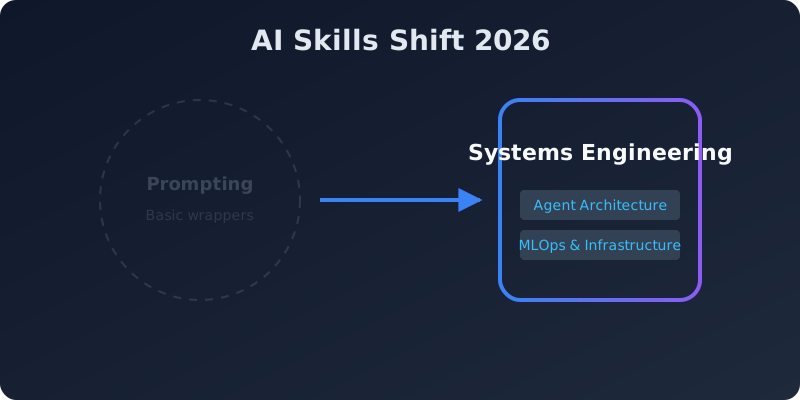
The job market today has decisively shifted away from basic wrapper development. Companies have realized that a thin layer of API calls wrapped in a sleek UI does not constitute a defensible product. Instead, the focus has moved toward AI Agent Architecture and multi-agent coordination.
Employers are aggressively hiring engineers who can build complex, stateful workflows where models can securely invoke tools, query databases, and handle long-running tasks. This requires deep knowledge of traditional software engineering, distributed systems, and modern MLOps.
Core Skills in Demand for 2026
- Agentic Orchestration: Understanding how to design systems where multiple models collaborate without devolving into infinite loops.
- Production-Grade RAG: Moving beyond naive similarity search to Hybrid Search architectures. Companies need engineers who understand RAG in Production—which involves Late Interaction Retrieval, continuous data ingestion, and rigorous evaluation frameworks.
- Evaluation and Reliability: Since you cannot write unit tests for every possible generation, building statistical evaluation harnesses using LLM as a Judge frameworks and strictly enforced Structured Outputs is crucial.
Watch Out For
Don't brand yourself as a pure AI enthusiast who only knows how to use web interfaces. If your resume highlights "ChatGPT expertise" without any mention of cloud infrastructure, data pipelines, or system architecture, it signals a superficial understanding of how AI operates in the real world. The 2026 engineer treats the model simply as another component in a complex, distributed microservices environment.
(Correct as of September 2026).
The Quick Version
The era of relying solely on prompt hacking is over. The most lucrative and stable AI careers in 2026 demand a hybrid skill set: the ability to understand model limitations paired with rigorous backend systems engineering.