Stop Overcomplicating Your First Python ML Model
The biggest mistake new developers make when getting into machine learning is reaching for the heaviest tools first. They watch a few videos, download PyTorch or TensorFlow, and immediately try to build a deep neural network to predict housing prices.
This is the equivalent of learning to drive in an F1 car. You are going to crash, and you aren't going to understand why.
Why You Should Start with Scikit-Learn
If you are building your very first ML model in Python as of late 2026, you should be using Scikit-Learn. Period.
Deep learning frameworks are built for scale, complexity, and hardware acceleration (GPUs). They require you to understand tensor dimensions, batching, epochs, and learning rate scheduling just to get a model to compile.
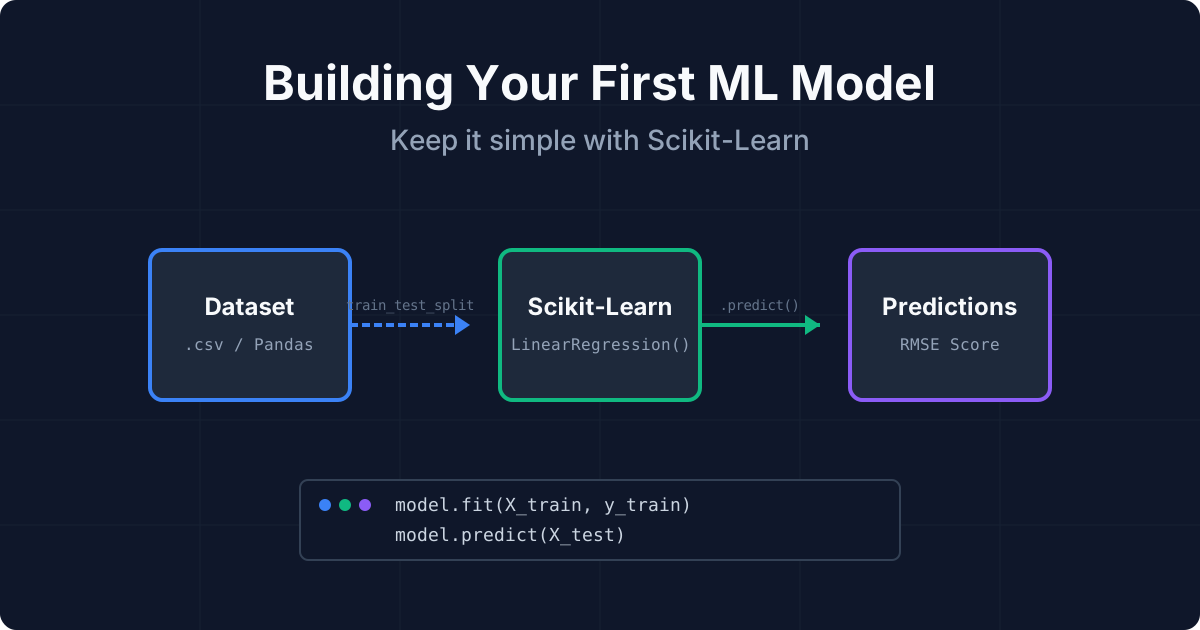
Scikit-Learn, on the other hand, is built for understanding. Its API is famously consistent: instantiate a model, call .fit(), and call .predict(). It forces you to focus on the things that actually matter when you are starting out:
- Data Preparation: Handling missing values, encoding categories, and scaling features.
- Model Evaluation: Understanding metrics like RMSE for linear regression or Accuracy for classification.
- The Bias-Variance Tradeoff: Recognizing when your model is overfitting the training data.
The "Hello World" of ML
Here is what your first model should look like. No tensors, no backpropagation loops, just pure fundamentals:
import pandas as pdfrom sklearn.model_selection import train_test_splitfrom sklearn.linear_model import LinearRegressionfrom sklearn.metrics import mean_squared_error
# 1. Load the datadf = pd.read_csv('housing_data.csv')X = df[['square_feet', 'num_bedrooms', 'age_of_house']]y = df['price']
# 2. Split into training and testing setsX_train, X_test, y_train, y_test = train_test_split(X, y, test_size=0.2, random_state=42)
# 3. Initialize and train the modelmodel = LinearRegression()model.fit(X_train, y_train)
# 4. Predict and evaluatepredictions = model.predict(X_test)error = mean_squared_error(y_test, predictions, squared=False)print(f"Root Mean Squared Error: ${error:,.2f}")This code does exactly what the complex neural networks do: it learns a mapping from inputs (X) to outputs (y) by minimizing an error function. But it does it in 20 lines of readable code that executes in milliseconds on your CPU.
Walk Before You Run
The ecosystem has evolved rapidly. Today, you can pull open-source foundation models off Hugging Face that can write poetry or identify objects in real-time video. It is incredibly tempting to jump straight to the bleeding edge.
But the fundamentals haven't changed. The engineers fine-tuning those massive models spend their days doing exactly what you do in a basic Scikit-Learn script: formatting data, managing splits, evaluating metrics, and fighting overfitting.
Master the boring stuff first. The neural networks will still be there when you're ready.
(Correct as of September 2026).