Stop Treating ML Deployments Like Software Deployments: MLOps Best Practices
The most dangerous phrase in machine learning is, "It works on my validation set." We've all been there: a model achieves state-of-the-art accuracy in a Jupyter notebook, only to fail spectacularly within hours of going live in production.
The harsh reality—one that many engineering teams are still grappling with as of late 2026—is that deploying machine learning isn't like deploying traditional software. When you deploy a web service, the code remains static until you push a new update. When you deploy a model, you are shipping behavior that interacts with a constantly shifting world.
Here are the MLOps best practices that separate robust AI systems from brittle science experiments.
1. Version Your Models Like You Version Code
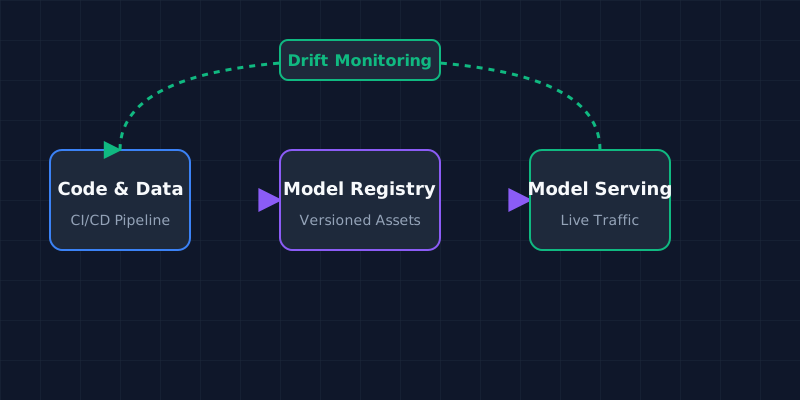
Traditional CI/CD for ML pipelines often breaks down because it assumes code is the only moving part. In MLOps, your artifact is the product of code, data, and compute environment.
Relying on a simple cloud storage bucket won't cut it. A dedicated model registry acts as your central source of truth, ensuring that you can instantly trace any production model back to the exact experiment tracking run that produced it. Without this lineage, rolling back a degraded model becomes a frantic guessing game.
2. Separate Deployment from Release
Deploying a model simply means putting it on a server where it can receive requests. Releasing a model means actively sending user traffic to it. You must decouple these two events.
Instead of hard cutovers, sophisticated teams use blue-green deployments or canary releases. By gradually shifting 5% of traffic to a new model and monitoring the outcomes, you contain the blast radius of any unexpected regressions. This is critical because an ML model can fail silently—it will happily return confident, incorrect predictions without ever throwing a 500 server error.
3. Monitor for Drift, Not Just Downtime
In standard DevOps, a 200 OK response means the service is healthy. In MLOps, a 200 OK response with a garbage prediction means you're actively losing money.
Because the world changes—user preferences shift, economic climates alter, and sensors degrade—your model's predictive power will inevitably decay. Robust model serving infrastructure must be paired with continuous model drift monitoring. You need automated alerts that trigger when the statistical distribution of live inference requests diverges from the training data, long before user complaints roll in.
The Reality Check
The shift from DevOps to MLOps isn't just about adding new tools; it's a fundamental mindset change. You are no longer managing code—you are managing a living system. Treat your deployments accordingly.
(Correct as of September 2026).