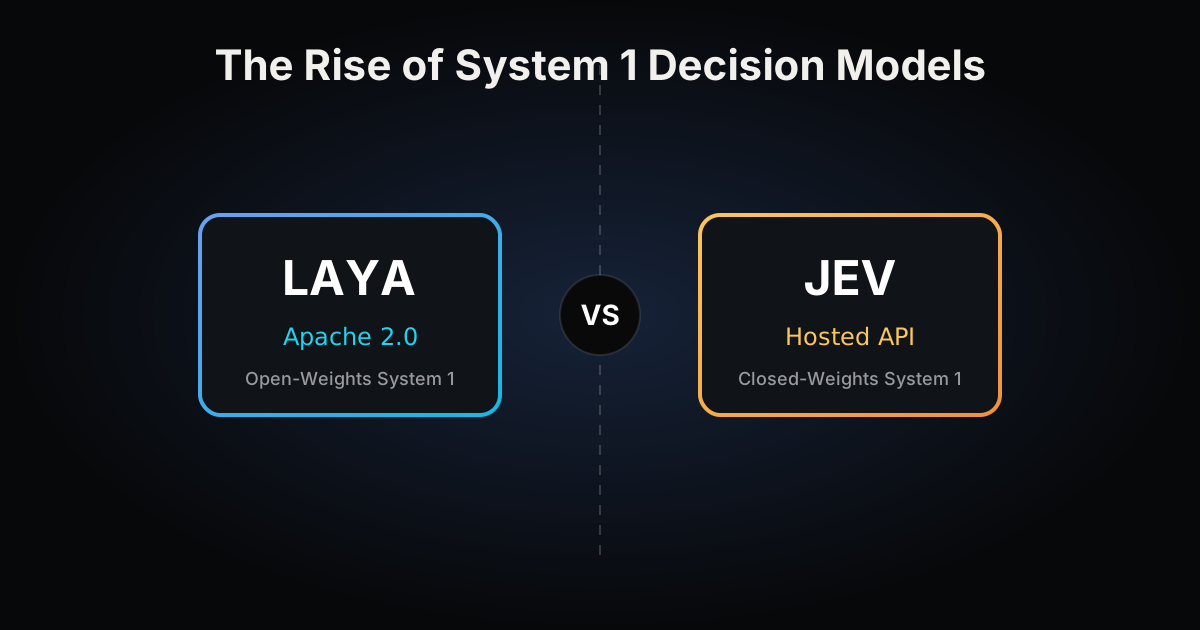
The Rise of System 1 Models: Laya vs. Jev
The release of Convai's Laya marks a structural shift in how we build agentic systems. For the past year, the standard practice for routing, classification, and metadata extraction was to throw a large, autoregressive LLM at the problem and hope the JSON parsing didn't fail.
Now, we have a true open-weights alternative to TypeSafe's Jev: a dedicated System 1 decision model.
Why the Agent Stack is Changing
Standard generative models (System 2) are slow, expensive, and fundamentally probabilistic text generators. When you need to triage a support ticket (category, severity, frustration level), you don't actually want text. You want a typed decision.
Laya, like Jev, is a non-autoregressive decision head built on an encoder backbone (the English checkpoint uses ModernBERT-large). It reads a state—like an email or a JSON payload—and answers typed Choice, Score, and Noul questions in a single forward pass. Because it never generates text, there is zero risk of hallucination and nothing to parse. The result? Calibrated probabilities in about 33 milliseconds.
The Benchmark Caveat
As always with model news, single-run benchmark numbers are marketing, not evidence.
Laya advertises an impressive 0.766 accuracy on the typed-decisions benchmark, but look closely at the fine print: that figure requires fine-tuning on the benchmark's own training split. Out of the box (zero-shot), its accuracy on that same benchmark is 0.362—near random. Furthermore, the comparisons to Jev often rely on third-party published figures with differing sample sizes and prompts.
The takeaway? An open-weights decision model isn't a zero-ops magic bullet. It requires you to distill your own labelled data and fine-tune it for your specific domain to see those <50ms, highly accurate routing benefits.
Open Weights vs. Hosted API
The choice between Laya and Jev comes down to control. Laya is Apache 2.0 licensed, meaning you can self-host it, fine-tune it on your private data, and eliminate network latency from your critical path. Jev remains the hosted "easy button" for teams that don't want to manage laya-serve or deal with TensorFlow hang gotchas (USE_TF=0).
We are entering an era where the heavy lifting is done by a large reasoning model, but the fast, deterministic routing in front of it is handled by a System 1 classifier. Laya just made that architecture accessible to everyone.
(Correct as of September 2026).