AI Agents vs RPA
Comparing intelligent, adaptive AI Agents with rules-based Traditional Automation (RPA).
AI AgentsvsRPA
Verdict: Use RPA for rigid, unchanging workflows with structured data; use AI Agents for fuzzy tasks requiring reasoning, unstructured data parsing, or dynamic decision-making.
The Short Answer
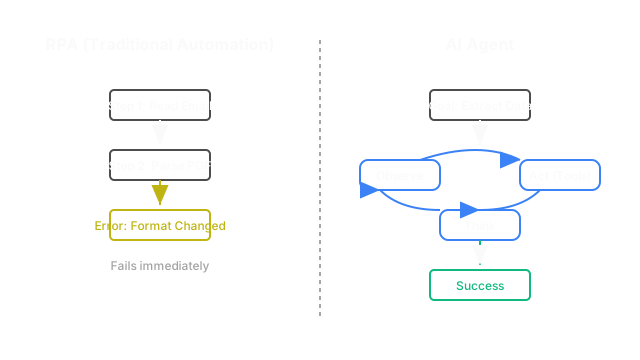
RPA (Robotic Process Automation) is a deterministic bot that strictly follows a pre-programmed script (e.g., "click here, copy this cell, paste it there"). It breaks the moment the UI changes or the data format shifts. AI Agents are goal-driven systems powered by LLMs that figure out the steps on their own. They can handle unstructured data, adapt to unexpected errors, and make contextual decisions without hardcoded rules.
Where They Differ
| Feature | RPA (Traditional Automation) | AI Agents |
|---|---|---|
| Execution | Rules-based (If/Then/Else) | Goal-driven reasoning |
| Data Handling | Requires strictly structured data | Parses unstructured data (emails, PDFs) |
| Adaptability | Brittleness (fails if UI or format changes) | High (adapts to changes dynamically) |
| Setup Process | Mapping every possible edge case | Defining the goal, tools, and guardrails |
Choose AI Agents When
- The input is messy or unstructured: If the automation starts by reading a customer complaint email and deciding what category it belongs to, RPA will fail. An AI agent can parse the nuance and extract the needed entities.
- The environment is dynamic: Web scrapers or automations dealing with modern web apps break often when class names or layouts change. Agents can use DOM-parsing or tool-use to find the right action even if elements moved.
- The task requires reasoning: If the bot needs to resolve a conflict (e.g., "The invoice says 50 USD but the PO says 45 USD, check the email thread to see if a discount was approved"), an agent can synthesize the context and make a judgment call.
Choose RPA When
- The process never changes: If you are moving data between two legacy systems whose interfaces haven't been updated in ten years, a simple RPA script will run perfectly forever.
- You need 100% deterministic execution: In highly regulated environments where you must mathematically prove exactly what the system will do on step 4, RPA provides that guarantee.
- Latency is critical: RPA executes instantly because it doesn't need to ping an LLM API to decide what to do next.
What People Get Wrong
Assuming agents will replace all RPA