Comparison
CNN vs Vision Transformer
Comparing local inductive bias with global self-attention for computer vision.
Verdict: Use CNNs for limited data and strict latency budgets; use Vision Transformers for maximum accuracy when data and compute are abundant.
Quick Version (TL;DR)
Comparing local inductive bias with global self-attention for computer vision.
The Short Answer
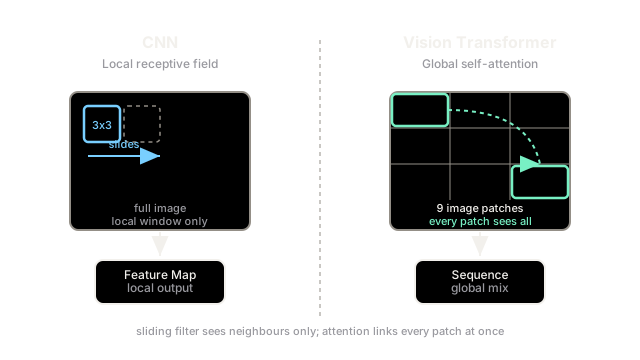
CNNs extract features locally using sliding windows, making them highly efficient and easy to train on small datasets. Vision Transformers (ViTs) divide images into patches and apply global self-attention, offering a higher accuracy ceiling but requiring vastly more data and compute to learn visual structures from scratch.
Where They Differ
| Feature | CNN (Convolutional Neural Network) | Vision Transformer (ViT) |
|---|---|---|
| Receptive Field | Local (grows deeper in the network) | Global (every patch attends to all others immediately) |
| Inductive Bias | High (assumes pixels close together are related) | Low (must learn spatial relationships from data) |
| Data Requirements | Moderate (trains well on smaller datasets) | Extreme (shines only on massive datasets like JFT-300M or ImageNet-21k) |
| Computational Cost | Generally lower, highly optimized for hardware | Quadratic with respect to the number of patches |
Choose A When
- You have limited training data: CNNs have strong inductive biases (translation invariance and locality) that help them generalize without needing millions of examples.
- You are deploying to edge devices: MobileNet and other CNN architectures remain the gold standard for low-latency, memory-constrained environments like smartphones and IoT devices.
Choose B When
- You have massive datasets: ViTs lack inductive biases, which makes them data-hungry but also prevents them from hitting the performance asymptotes that constrain CNNs.
- You are building multi-modal models: The Transformer architecture provides a unified language that can easily mix text, audio, and visual embeddings.
What People Get Wrong
People often assume Vision Transformers have completely replaced CNNs. In reality, most modern "ViT" architectures in production are hybrids (like MaxViT or ConvNeXt) that reintroduce convolutions to handle early-stage local feature extraction before applying attention globally.