Comparison
Constrained Decoding vs Output Parsing
Comparing methods for forcing LLMs to output valid JSON.
Verdict: Use Constrained Decoding (like Outlines or JSON mode) to guarantee perfect schema generation in production; use Output Parsing only when forced to use older APIs that do not support constraint passing.
Quick Version (TL;DR)
Comparing methods for forcing LLMs to output valid JSON.
The Short Answer
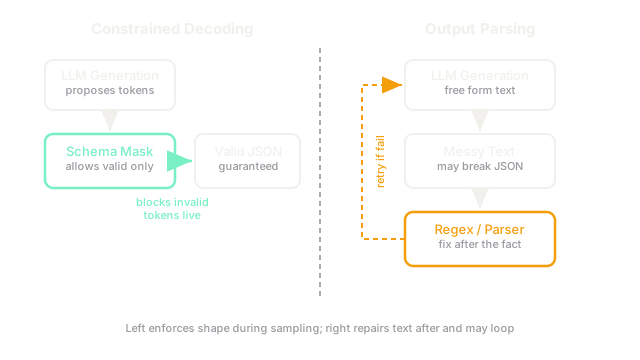
When you need an LLM to output rigid JSON, Output Parsing lets the model generate whatever text it wants, and then a script uses Regex to hunt for the JSON, parse it, and throw an error (or ask the model to retry) if it's malformed. Constrained Decoding intercepts the model at the very lowest level, masking out any token that would violate your JSON schema before it generates it, guaranteeing 100% valid JSON on the first try.
Where They Differ
| Feature | Constrained Decoding | Output Parsing |
|---|---|---|
| Where it happens | During token generation (inside the model) | After token generation (in your app code) |
| Reliability | 100% guaranteed schema adherence | Often fails (requires retry loops) |
| Latency | Extremely fast | Slower (especially if retries trigger) |
| Support | Supported by all modern API providers (OpenAI Structured Outputs, vLLM) | Fallback method |
Choose Constrained Decoding When
- You are building an AI Agent: Agents rely on strictly formatted API calls to use tools. If an agent hallucinates a trailing comma in its JSON, the tool call fails and the agent crashes. Constrained decoding (Structured Outputs) completely eliminates this class of error.
- You are extracting data at scale: If you are processing 10,000 resumes into structured database rows, you cannot afford a 5% failure rate on JSON parsing. Constrained decoding guarantees every single output will insert cleanly into your database.
Choose Output Parsing When
- You are using older or primitive models: If you are using a legacy API endpoint or a primitive local runner that does not support constrained decoding natively, you have no choice but to prompt heavily ("You MUST output JSON") and rely on Output Parsing scripts to clean up the mess.
What People Get Wrong
People assume that passing a JSON schema to a model just "tells it what to do better" (prompt engineering). In true Constrained Decoding (like OpenAI's Structured Outputs or the outlines library), it literally alters the probability distribution of the model at runtime. If the model is generating {"name": "John", the probability of it generating an invalid token next is artificially clamped to exactly 0%, forcing it to generate a valid } or ,.