Comparison
Dense vs Mixture of Experts
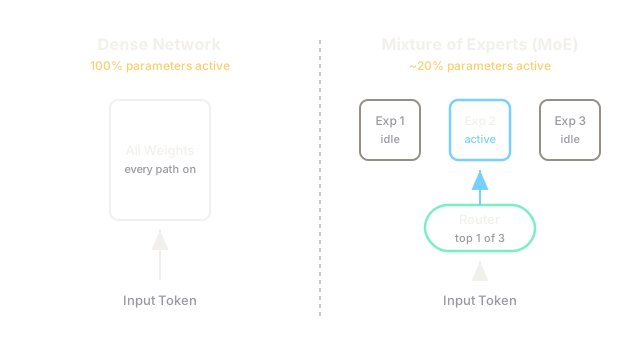
Comparing total parameter count with active parameter count during inference.
Verdict: Use MoE when you want to drastically scale up a model's knowledge capacity without proportionally increasing inference latency and cost.
Quick Version (TL;DR)
Comparing total parameter count with active parameter count during inference.
The Short Answer
In a Dense neural network, every single parameter is used to process every single token, meaning the compute cost scales directly with the model size. A Mixture of Experts (MoE) network contains many sub-networks ("experts"), but uses a routing mechanism to activate only a few of them per token, breaking the link between total parameter count and inference cost.
Where They Differ
| Feature | Dense | Mixture of Experts (MoE) |
|---|---|---|
| Parameter Usage | 100% active per token | Typically 10–25% active per token |
| Inference Compute (FLOPs) | Proportional to total parameter count | Proportional to active parameter count |
| VRAM Requirement | High (must load all weights) | Very High (must load all experts into memory) |
| Knowledge Capacity | Bound by active compute limits | Vastly higher than compute limits imply |
Choose A When
- You are constrained by VRAM: MoE models require massive amounts of memory because all experts must be loaded onto the GPU, even if only a few are used at a time. Dense models offer a much better ratio of VRAM usage to output quality.
- You are fine-tuning on a small dataset: MoE routing mechanisms can be unstable or suffer from "expert collapse" (where the router sends everything to one expert) if fine-tuned carelessly on narrow datasets.
Choose B When
- You need maximum quality at low latency: If you want the knowledge capacity of a 70B model but only want to pay the inference latency of a 14B model, MoE is the standard architectural trick to achieve this (e.g., Mixtral 8x7B).
- You are serving models at immense scale: For large API providers, the compute savings per token heavily outweigh the VRAM costs, making MoE the default architecture for frontier models (like GPT-4).
What People Get Wrong
People often equate an "8x7B" MoE model with a 56B dense model in performance. In reality, an 8x7B model might only perform on par with a 30B dense model, because the experts share many parameters (like the attention mechanism) and the sparse routing introduces inefficiencies. You are trading VRAM for speed, not getting parameters for free.