Comparison
Gradient-Boosting Libraries Compared
Comparing XGBoost, LightGBM, and CatBoost for tabular data tasks.
Verdict: Use LightGBM for the fastest training on massive datasets; use CatBoost if your dataset is dominated by categorical features; use XGBoost if you want the most battle-tested, widely supported implementation.
Quick Version (TL;DR)
Comparing XGBoost, LightGBM, and CatBoost for tabular data tasks.
The Short Answer
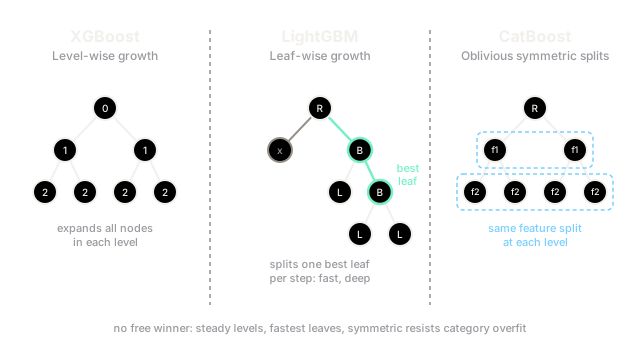
All three are highly optimized implementations of Gradient Boosted Decision Trees (GBDT). XGBoost is the gold standard that popularized the technique. LightGBM (by Microsoft) focuses heavily on training speed by growing trees asymmetrically. CatBoost (by Yandex) is explicitly designed to handle categorical data automatically without requiring you to manually one-hot encode it.
Where They Differ
| Feature | XGBoost | LightGBM | CatBoost |
|---|---|---|---|
| Tree Growth | Level-wise (symmetric) | Leaf-wise (asymmetric) | Oblivious (symmetric, shared splits) |
| Training Speed | Fast | Fastest | Slower |
| Categorical Data | Needs manual encoding | Supports it natively | Exceptional native support |
| Overfitting Risk | Moderate | Higher (leaf-wise growth digs deep) | Lowest (oblivious trees act as strong regularizers) |
Choose XGBoost When
- You want maximum compatibility: XGBoost has the oldest, most robust ecosystem. It integrates flawlessly with Spark, Dask, Kubernetes, and almost every model serving infrastructure in existence.
Choose LightGBM When
- You have a massive dataset: LightGBM was built to scale. By grouping continuous features into discrete bins (histogram-based) and growing trees leaf-wise (only splitting the node that reduces error the most), it trains significantly faster than XGBoost with lower memory usage.
Choose CatBoost When
- Your data has many categorical columns: (e.g., City names, User IDs, Product categories). CatBoost uses advanced target encoding under the hood, saving you from writing brittle preprocessing pipelines.
- You want great out-of-the-box results: CatBoost is famous for requiring very little hyperparameter tuning to achieve top-tier performance on tabular tasks.
What People Get Wrong
People often assume one library is strictly more accurate than the others. In competitive data science (like Kaggle), the winning solution almost always involves training all three and ensembling their predictions together, because their different tree-growth strategies cause them to make slightly different, uncorrelated errors.