Comparison
LLM-as-a-Judge vs Human Evaluation
Comparing automated, highly scalable grading with ground-truth human assessment.
Verdict: Use Human Evaluation to establish the initial ground-truth baseline; use LLM-as-a-Judge for fast, automated regression testing on every pull request or prompt change.
Quick Version (TL;DR)
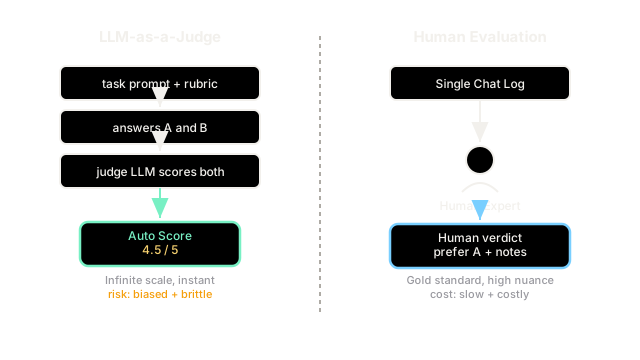
Comparing automated, highly scalable grading with ground-truth human assessment.
The Short Answer
When evaluating if a chatbot gave a "good" answer, Human Evaluation involves paying experts to read the conversation and score it. It is perfectly accurate but extremely slow. LLM-as-a-Judge takes the chatbot's answer and feeds it to a larger, smarter model (like GPT-4), asking the smart model to grade the answer on a scale of 1 to 5. It is incredibly fast, scalable, and surprisingly aligned with human judgment.
Where They Differ
| Feature | LLM-as-a-Judge | Human Evaluation |
|---|---|---|
| Throughput & Speed | Thousands of grades per minute | A few grades per hour |
| Cost | Pennies per evaluation | High (Hourly wages) |
| Consistency | Extremely consistent (deterministic at temp 0) | Varies from person to person |
| Nuance & Tone | Struggles with sarcasm and deep subtlety | Excellent |
Choose LLM-as-a-Judge When
- You are doing Continuous Integration (CI/CD): If you tweak a system prompt, you need to know immediately if it broke your application. You can run 500 test questions through your app, have an LLM judge score all 500 answers in 30 seconds, and block the deployment if the score drops below 4.5/5.
- You are monitoring production logs: It is impossible for humans to read every chat log. LLM judges can silently score 100% of user conversations in the background, flagging the worst 1% for human review.
Choose Human Evaluation When
- You are creating the benchmark itself: An LLM-as-a-Judge is only useful if it agrees with what your company considers a "good" answer. You must do human evaluation on a golden dataset of 100 questions first, to ensure the LLM judge's scores actually align with your business goals.
- You are evaluating highly subjective or creative text: LLMs have strong internal biases (e.g., they heavily prefer long, verbose answers with bullet points). If you are evaluating poetry, humor, or brand voice, humans must make the final call.
What People Get Wrong
People often distrust LLM-as-a-Judge because they assume an AI shouldn't grade itself. The trick is to use a stronger model as the judge. If your production app uses a fast 8B parameter model, you use a massive frontier model (like Claude 3.5 Sonnet) as the judge. Studies consistently show that frontier models align with expert human graders over 85% of the time, making them a perfectly viable proxy for rapid testing.