LangChain vs LlamaIndex
Comparing the two dominant frameworks for building LLM applications, agents, and RAG pipelines.
Verdict: Use LlamaIndex for RAG and data-heavy applications. Use LangChain for general-purpose agents and complex multi-tool workflows.
The Short Answer
Both frameworks help you build LLM applications, but they approach the problem from different angles.
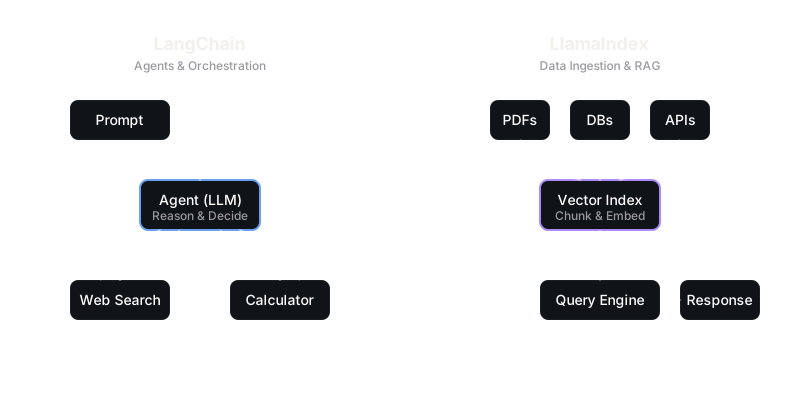
LangChain is a general-purpose orchestration framework. It provides thousands of integrations for LLMs, tools, memory, and prompts, letting you chain them together to build complex, autonomous agents. LlamaIndex is a data framework. It excels at ingesting, structuring, and retrieving your private data so that an LLM can reason over it, making it the premier choice for Retrieval-Augmented Generation (RAG).
Where They Differ
| Feature | LangChain | LlamaIndex |
|---|---|---|
| Primary Focus | General-purpose orchestration and Agents | Data connection, indexing, and RAG |
| Core Abstraction | "Chains" (LCEL) and Tools | Indices (Vector, Tree, Keyword) and Query Engines |
| Integrations Ecosystem | Massive (almost every tool, DB, and API) | Broad, but focused on data loaders and vector stores |
| RAG Capabilities | Basic out-of-the-box, highly customizable | Extremely advanced (sub-document routing, hierarchical indexing) |
| Agent Capabilities | Industry standard (ReAct, Plan-and-Execute) | Good, particularly for "Data Agents" routing between data sources |
Choose LangChain When
- You are building an autonomous agent: If your application involves an LLM deciding when to search the web, when to run Python code, and when to query an API, LangChain's agent abstractions and massive tool ecosystem are best-in-class.
- You need complex workflows: When your application requires multiple LLMs talking to each other, passing memory back and forth, or using custom logical chains.
- You want to use LangGraph: LangChain's graph-based framework for stateful, multi-actor applications is powerful for production-grade agentic systems.
Choose LlamaIndex When
- You are building a RAG application: If the core value of your application is answering questions over your private data (PDFs, Notion, databases), LlamaIndex is purpose-built for this.
- You have complex document structures: LlamaIndex provides advanced ingestion tools (LlamaParse) and indexing strategies (document hierarchies, sentence window retrieval) that take weeks to build from scratch in LangChain.
- You need advanced retrieval strategies: Things like query decomposition, hypothetical document embeddings (HyDE), and sub-question query engines are first-class citizens in LlamaIndex.
What People Get Wrong
Assuming they are mutually exclusive
Many enterprise applications use both. It is very common to use LlamaIndex to build an advanced, high-precision retrieval engine for a company's internal documents, and then wrap that engine as a "Tool" inside a larger LangChain agent that also has access to web search and calculators.